
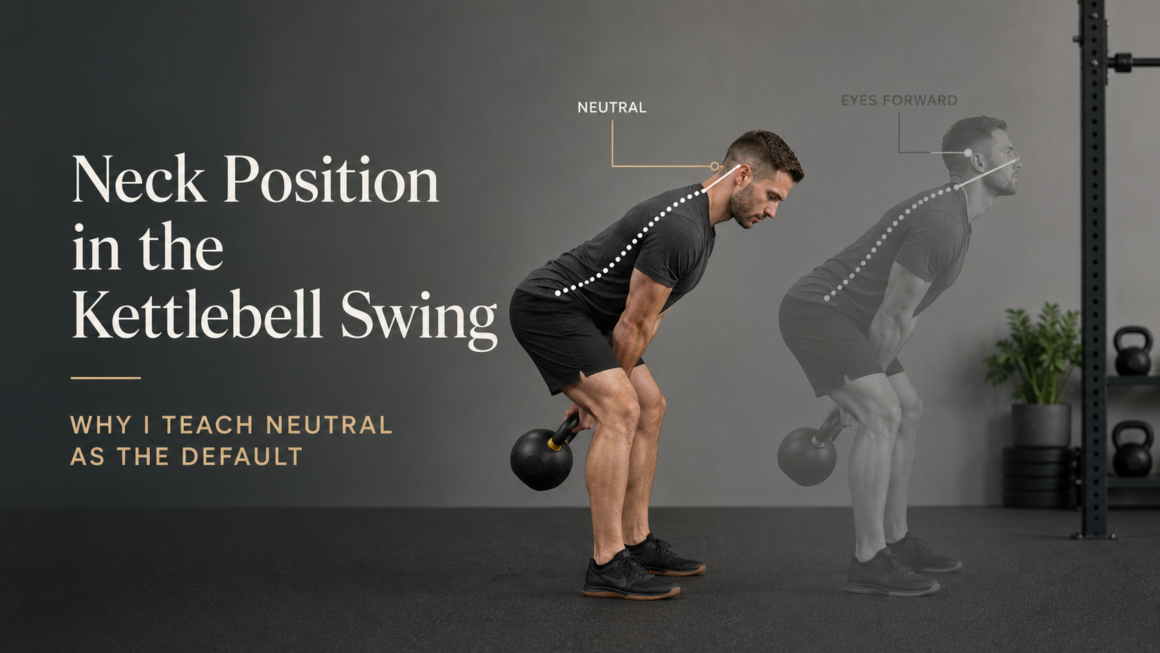

Should you keep your cervical spine neutral during the kettlebell swing, or should you keep your eyes forward as you hinge?
I have been promoting keeping the whole spine neutral, including the cervical spine.
I obtained SFG Level I and II, but this is not something I took from StrongFirst. In fact, StrongFirst has traditionally taught a different approach: keeping the eyes toward the horizon and allowing the neck to extend at the bottom of the swing.
My preference for neutral developed from working with beginners, thinking about progression, and asking a fairly simple question:
If someone can maintain the position required for the swing with the cervical spine neutral, why deliberately add cervical extension to every repetition?
That doesn’t mean cervical extension is automatically wrong or dangerous. It means I want there to be a reason for adding it.
What Does “Eyes on the Horizon” Actually Mean?
StrongFirst describes its standard recommendation as keeping the eyes on the horizon, which they say places the neck into “mild extension” at the bottom of the swing. They also make clear that the horizon does not necessarily mean eye level. Indoors, they suggest looking toward something lower, such as where the wall meets the floor, an electrical outlet, or a point several feet in front of you.
That distinction matters.
If your cervical spine remains neutral while you hinge, your head essentially follows the inclination of your torso. As your torso moves toward horizontal, your face and gaze naturally become directed farther toward the floor.
If you instead maintain your gaze farther forward while the torso continues to incline, the relationship between your head and torso has to change. Some of that can come from moving the eyes, but beyond that you need cervical extension.
The amount of extension therefore isn’t fixed by the words “look at the horizon.”
It depends on how deeply you hinge, where you are actually looking, how much you move your eyes rather than your head, your individual anatomy and mobility, and how you interpret the cue.
This is why I am hesitant to simply describe the resulting position as mild extension in every person.
A relatively upright torso with a low focal point may involve very little cervical movement. A deeper hinge combined with an attempt to keep the face looking straight ahead can result in considerably more.
StrongFirst itself recognizes this problem. Their guidance warns that someone with insufficient upper-back mobility may compensate by hyperextending the neck, and they specifically caution against whipping the neck backward or developing a repeated “bobble head” movement.
So there is an important difference between the position StrongFirst intends and what a beginner may actually produce from the instruction “look forward.”
There is another practical issue here: many people learning kettlebell swings today are not standing next to a qualified kettlebell coach receiving all of those details.
They may see a short YouTube video, an Instagram clip, a Reddit comment, or simply hear the cue “look at the horizon.”
What may originally have been a more detailed technical instruction gets reduced to a few words. The beginner may never be told how low the focal point can be, how much cervical extension is actually intended, or that excessive extension and repeated head movement should be avoided.
That matters because a cue that works when it is carefully explained and monitored by a coach may produce something very different when someone tries to interpret it on their own.
Why Does StrongFirst Teach Cervical Extension?
There is reasoning behind their approach.
Pavel Tsatsouline argues that extending the neck helps facilitate the extensor musculature and reinforces the posterior chain during explosive pulling. In the StrongFirst model, the hardstyle swing is about aggressively accelerating the kettlebell, so they intentionally use head and neck position as part of that overall extensor pattern.
StrongFirst therefore does not regard some cervical extension as an unwanted compensation. It is deliberately included in the technique.
And this is where things become interesting, because I have seen something related when working with beginners myself.
I simply draw a different conclusion from it.
Looking Forward Can Be a Useful Cue
Some beginners have difficulty maintaining their upper-back position during a hinge.
They may round excessively.
They may lack the strength and endurance to maintain the position.
Or they may have enough strength but lack the awareness and motor control to create the position consistently. In everyday coaching language, they may lack the mind-muscle connection with that area.
For some of those people, asking them to look forward can immediately help.
The chest comes up.
The upper back organizes differently.
The person suddenly understands what you have been trying to get them to do.
I have used that cue.
But to me, this is the important distinction:
A useful cue does not necessarily have to become the permanent technique.
If looking forward helps a beginner find the position, I can use it while we work on what is actually missing.
If they need more strength, we develop strength.
If they need better awareness and motor control, we work on that.
If mobility is genuinely limiting them, we address the relevant mobility.
Over time, I want them to become capable of creating and maintaining the desired position without needing to extend their neck to help them do it.
Then the cue can go away.
Why I Prefer Neutral as the Default
For me, this is primarily a question of progression.
The kettlebell swing is already a fast, repetitive ballistic exercise. A beginner has to learn the hinge, timing, force production, the path of the kettlebell, bracing, breathing, grip, and how to receive and redirect the bell on the backswing.
I don’t see a reason to add another repeated movement unless that movement serves a useful purpose.
With a neutral cervical spine, the head remains organized with the torso throughout the hinge.
With intentional cervical extension, the relationship between the head and torso changes as the person moves into and out of the backswing.
That does not mean cervical extension is inherently dangerous. But it does introduce another movement, another muscular demand, and another opportunity for error.
For a beginner, I consider that less forgiving than simply keeping the cervical spine neutral—particularly when they may not yet understand how much extension is intended.
For an experienced athlete, that may be completely unremarkable.
For a beginner who is still learning the basic movement, I prefer to keep things as simple as possible.
Don’t add movement merely because it can be added. Add it when there is a reason for it.
The Beginner Problem With “Look Forward”
This is probably the biggest practical reason I don’t like using “eyes on the horizon” as a universal beginner instruction.
A coach may understand the intended meaning as:
Use an appropriate focal point and allow some controlled cervical extension without hyperextending or throwing the head backward.
A beginner may hear:
Keep looking straight ahead.
Those are not necessarily the same thing.
And in many cases there may be no coach present to correct that interpretation.
Someone learning from social media may perform hundreds of repetitions before anybody tells them that the amount of cervical extension they are using was never what the original instruction intended.
As the beginner hinges deeper, they may lift the chin farther and farther to keep looking forward.
They may exaggerate the cervical extension.
They may move the head independently on each repetition.
Or they may start using the neck to help produce the upper-body position that they currently lack the strength or control to maintain elsewhere.
StrongFirst’s own instruction acknowledges these possible errors and specifically warns against cervical hyperextension and whipping the head during the swing.
There is also the question of conditioning and volume.
A beginner may not normally perform repeated loaded cervical extension at all. Then they begin swinging, are told to keep looking toward the horizon, and may suddenly perform 50, 100, or more repetitions in a session or accumulate substantial volume over a week.
How much extension are they actually using on each repetition? Where does “mild” end? That is particularly difficult for a beginner to judge.
Even if the intended position is reasonable, an unconditioned beginner repeatedly taking the neck farther into extension than intended is a very different situation from an experienced athlete performing a small, controlled amount of extension.
My preference is to avoid creating that problem in the first place when there is no need for the person to use that strategy.
Teach neutral first.
Then deviate from neutral if there is a reason.
Neck Position Does Affect the Rest of the Movement
There isn’t much direct research specifically comparing neutral cervical positioning with cervical extension during kettlebell swings.
But we do have broader lifting research showing that neck position isn’t an irrelevant detail.
One lifting study compared neutral, flexed, and forward-head positions and found that cervical posture changed the behavior of the dorsal neck musculature during the lifting task. The authors concluded that neck posture should be considered when evaluating lifting because it changes muscular demands.
Another small study examined neck position during lifting and found that changing neck posture altered both trunk muscle activation and lumbar-spine posture. The study included only seven participants, so it should not be treated as definitive evidence, but it does support the principle that changing the position of the head and neck can influence what happens farther down the kinetic chain.
That makes sense mechanically. The body does not operate as a collection of completely independent pieces.
Changing head and neck position can change the way a person organizes the rest of the movement.
Interestingly, that broader principle is also central to StrongFirst’s argument. Their reason for extending the neck is precisely that they believe doing so influences the overall extensor pattern.
So the disagreement is not really over whether head position can affect the rest of the body.
The disagreement is over how we want to use that effect.
Where My Approach Differs
StrongFirst uses cervical extension as part of the finished technique because they believe it contributes to the posterior-chain pattern and power production they want from the hardstyle swing.
I may exploit a similar relationship temporarily when looking forward helps a beginner organize their upper body.
But I then want to remove the need for it.
My reasoning is:
If extending the neck helps someone compensate for a weakness or lack of control, develop the missing strength or control rather than making the compensation permanent.
That is really the central difference.
I want the person to become capable of maintaining the upper back and trunk position independently.
Once they can do that, I see no need to deliberately extend the cervical spine on every repetition.
What About Injury Risk?
There is no direct research, as far as I have found, comparing injury rates between a neutral cervical spine and cervical extension during kettlebell swings.
So I cannot say that research has proven neutral to be safer.
But that does not mean I consider the two approaches equally forgiving for a beginner.
Over the years, beginners have approached me complaining about their neck after performing kettlebell swings. One of the first things I ask is where they are looking during the backswing, and repeatedly I have been told that they were looking toward the horizon.
That observation does not prove that cervical extension caused their discomfort. But it is one of the reasons I have continued to question whether this should be the default instruction for beginners.
The existing lifting research tells us that cervical position changes muscular demands and can influence what happens elsewhere in the trunk. We also know that StrongFirst itself recognizes excessive cervical extension and repeated neck whipping as undesirable.
Then add the practical realities of a beginner:
They may not understand how much extension is intended.
They may hinge deeper than expected.
They may interpret “look at the horizon” as “keep looking straight ahead.”
They may take the neck considerably farther into extension than what the coach considers mild.
And they may repeat that position dozens or hundreds of times before they have developed any specific conditioning for it.
For those reasons, I consider intentional cervical extension the more injury-prone option for beginners compared with keeping the cervical spine neutral.
That is my coaching judgment, not a claim that a controlled study has demonstrated a higher injury rate.
Neutral removes that additional variable. The head remains organized with the torso, there is no question about how much cervical extension is “mild,” and there is less opportunity for the beginner to exaggerate the position.
If both approaches allow the swing to be performed effectively, I prefer to start with the one that I consider simpler, more forgiving, and less prone to being performed incorrectly.
But Does Cervical Extension Produce More Power?
This is the other side of the question.
StrongFirst’s rationale is that neck extension helps reinforce the posterior chain and therefore supports the explosive nature of the hardstyle swing. Pavel makes that case explicitly in StrongFirst’s technical guidance.
What I have not found is direct kettlebell-swing research demonstrating that deliberately extending the cervical spine produces greater swing power than maintaining it neutral.
That distinction matters.
There can be a logical or experiential reason for a coaching technique without that technique having been demonstrated experimentally to improve the outcome being claimed.
And StrongFirst’s own article contains an interesting example: Pavel identifies Master SFG Brett Jones as someone capable of a powerful hardstyle swing while keeping his neck close to neutral. Jones describes preferring a closer focal point because maintaining a farther-forward gaze made him feel as though he was being pulled into cervical extension.
That does not prove neutral is superior.
But it does demonstrate that a powerful hardstyle swing is possible without making substantial cervical extension the defining feature of the movement.
The Progression I Prefer
My approach with a beginner is straightforward.
1. Start with the whole spine neutral
Teach the hinge while keeping the cervical spine organized with the rest of the spine.
As the torso inclines, allow the head and gaze to follow naturally rather than trying to keep the face pointing forward.
2. See whether they can maintain the desired upper-back position
If they round or lose position, determine what is actually happening rather than immediately changing their neck position.
3. Use looking forward if it solves a specific problem
If the person cannot understand or maintain the upper-back position and looking forward immediately helps them create it, use the cue.
There is nothing wrong with a temporary coaching tool.
4. Work on what they are missing
Develop the relevant upper-back strength.
Improve their awareness and motor control.
Address mobility where mobility is actually limiting them.
Give them time to become conditioned to the movement.
5. Remove the cue
Once they can maintain the position without it, let the cervical spine remain neutral.
The goal is not to become better at following the cue.
The goal is to eventually no longer need the cue.
Cue or Technique?
This is ultimately how I look at it.
I have no problem telling someone to look forward if doing so immediately improves something I am trying to teach them.
But I distinguish between:
“Do this because it helps you understand the position right now.”
and
“This movement must remain part of every repetition you perform from now on.”
Those are two very different statements.
In coaching, we constantly use cues that exaggerate something, create a feeling, or help someone understand a position.
Once the person owns the movement, that cue may no longer be necessary.
For me, cervical extension can fall into that category.
My Position
I am not arguing that cervical extension is inherently dangerous, nor am I claiming that research has proven neutral cervical positioning prevents kettlebell-related neck injuries.
I am saying that, particularly for beginners, I consider neutral the more conservative and forgiving option. Cervical extension introduces another movement to control, the amount of extension intended is not clearly defined by a cue such as “look at the horizon,” and beginners can easily exaggerate it while accumulating a lot of repetitions.
My position is simpler.
I teach neutral as the default.
If someone cannot maintain the required upper-back position and looking forward helps them find it, I may temporarily use that cue.
Then we work on the underlying reason they needed it.
We develop the strength.
We develop the awareness.
We develop the motor control.
And eventually we remove the cue.
If an athlete can maintain the required position and produce a powerful swing while keeping the cervical spine neutral, I have not seen sufficient evidence that deliberately introducing cervical extension provides a benefit that makes it necessary.
So, particularly with beginners, my progression remains:
Start neutral. Add something only when there is a reason. And if that addition is solving a weakness or lack of control, work toward no longer needing it.
- Workouts
- Courses
- Certifications
- Coaches
- Live feed

