
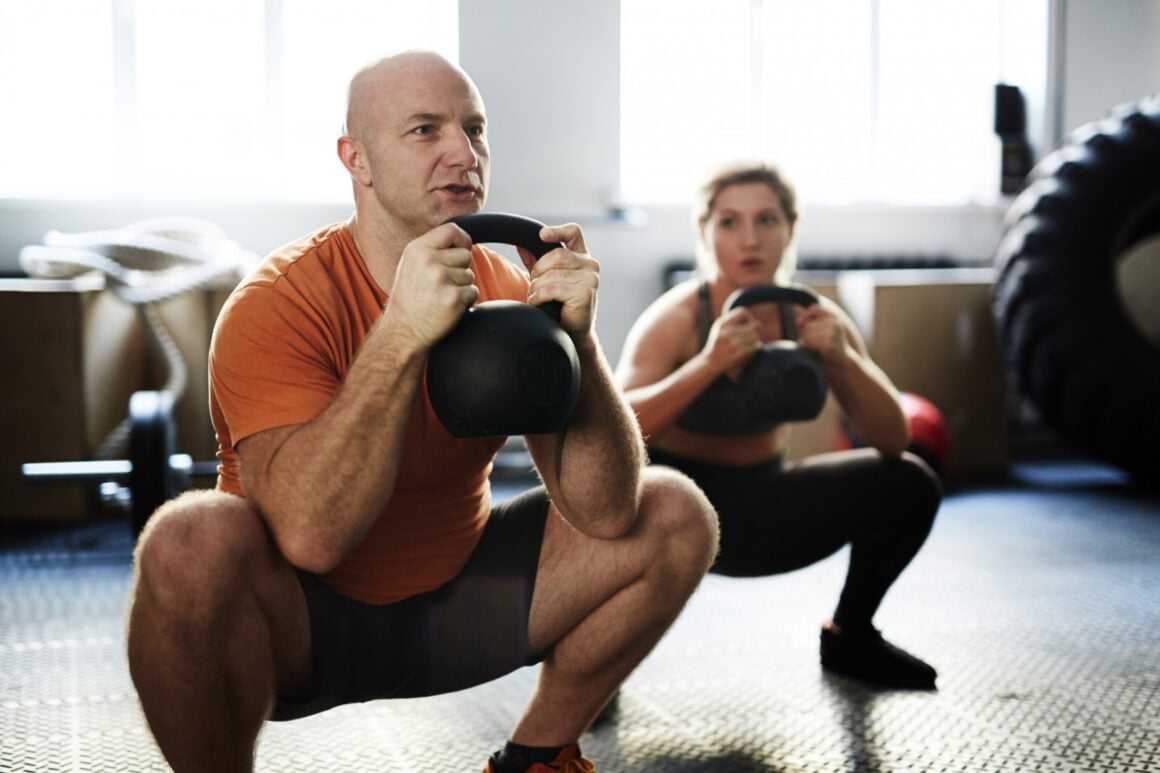

Ask a kettlebell person what they like about the bell, and the answer is usually some version of speed. The swing has a snap to it. A snatch finishes with that little punch through the handle. Slow squats rarely make the list.
I still think a slow day deserves a spot in the week, and the research on rep speed supports a modest version of that case.
What the studies say about rep speed
Rep speed has been studied more than you’d guess. The review most people cite is a 2015 meta-analysis from Brad Schoenfeld’s group, published in Sports Medicine. Eight studies made the cut. Each ran for at least six weeks, took people to failure, and measured muscle size. Reps lasting anywhere from about half a second to eight seconds grew muscle about equally. Very slow reps, over ten seconds, may grow less, but the authors said there were too few controlled studies to be sure.
A swing lasts a second or two. A controlled squat can last six or eight. Both sit inside that half-second to eight-second range. If somebody tells you slow reps are the secret to muscle, this paper doesn’t back them up.
A 2021 review of movement tempo, also in Sports Medicine, was just as cautious. Its authors found the research too mixed for firm conclusions, and noted that the long-term effect of slowing down only the lowering phase, or only the lifting phase, hadn’t been studied.
My own reason for slowing down has nothing to do with growth. Give a squat three seconds down and a pause at the bottom, and faults show up that speed would hide: knees drift, ribs flare, one heel comes up.
Neither review was about kettlebell training, so I use them only as a general guide.
Swings work, and that’s the catch
Let me be fair to the swing, because it earns its reputation. In a 2012 study in the Journal of Strength and Conditioning Research, twenty-one men trained the kettlebell swing twice a week for six weeks.
Their half-squat max went up by about 10 percent and their vertical jump by nearly 20 percent, which matched a group doing jump squats. The participants were healthy men aged 18 to 27, so the results may not carry over to people who already train hard.
Still, it’s a fair sign that the bell builds real strength and power.
The catch comes when swings are the whole plan, for example, a hundred swings with a 24 kg bell, three times a week, and nothing else. That trains your swing and your conditioning well, but every rep moves at roughly the same speed, and nothing gets squatted, carried, or held still.
One slow session
You need a light kettlebell for most of this session, plus a heavier one for the carry if you have one. Warm up first, and when you choose the light one, go lighter than you think you need.
- Goblet squat. 3 x 8, counting 3 down, 1 hold, 2 up. A bell you’d usually manage twelve reps with is about right. The hold is where knees folding in or a heel peeling up will show.
- Kettlebell deadlift. Three sets of 6 at a 4-1-2 count, holding an inch off the floor. If you swing with a hip hinge, the deadlift uses the same hinge, so slow practice here is as near to that swing as you can get without swinging.
- Turkish get-up (only if you already own it). One rep per side, a breath at every stage. The get-up is already a slow exercise: Cavemantraining™’s guide on how fast to do the Turkish get-up works out to about 20 seconds up and 18 seconds down. The stage where you wobble is the one to work on. The get-up isn’t a beginner exercise, so if you can’t yet hold a kettlebell steady overhead for 30 to 60 seconds, or haven’t learned the windmill and the overhead reverse lunge, leave it out and give the time to the squat and the deadlift.
- Suitcase carry. Your heavier bell, or the same one if that’s all you have, 20 to 30 metres each side, no leaning. It works the trunk and asks nothing fast of you.
- Bottoms-up carry (optional). The light bell, a short distance, only if your wrists and shoulders are happy. Holding the bell upside down makes your grip and shoulder work harder, which is the point.
- Mobility. Five minutes of kettlebell mobility work for the hips and shoulders. A slow day suits it, since nobody’s racing a clock.
Don’t change everything at once. Add a second to the pause one week, bump up the carry bell another. If your reps get quicker and ragged, you’ve gone too heavy, so back off. If the hinge and the squat are still new to you, put your time there first, because the whole session rests on them.
Slow reps have their own ways of going wrong. One is diving through the descent and calling it a tempo. Another is turning the pause into a rest, with the bell parked on your chest and your back sagging into a comfortable slump.
The third is holding your breath for the whole rep. Breathe in on the way down, let a little out in the pause, and finish the breath as you stand. If any of those keep happening, the bell is probably too heavy for this kind of work. If your back hurts during or after the session, have it checked by someone qualified before you add load.
Keeping score
Film yourself. Prop the phone at hip height, shoot one goblet squat set from the side, then come back in week four with that same bell and count.
Then put the clips side by side and look at the bottom: how deep you went, whether your heels stayed down, whether your back rounded. Other signs are smaller. If you do the get-up, it stops wobbling at the half-kneeling stage. The carry stops pulling you sideways.
If you’d like someone else to look at your clips, CONNECT on KETTLEBELL MONSTER™ offers free form checks. You post one video, and a certified IKU™ coach marks where your form breaks down and gives you a list of things to work on.
Where it fits in the week
For adults, the US government’s physical activity guidelines set the floor at two days of muscle-strengthening a week. A three-day kettlebell week already clears that, so the real question is the mix.
I’d go with two fast days and one slow day, with a rest day on either side of the slow one. For example: swings and cleans on Monday, the slow session on Wednesday, snatches or heavier swings on Friday. That way your back isn’t tired from heavy swings when you hold a pause under load. If you train four times a week, make it two fast and two slow, and avoid putting a slow day straight after your heaviest swings.
Expect the weights to feel light at first.
If you’ve mostly been using the bell for conditioning, a slow day is a quick way to find out how much strength work a kettlebell can do.
Pilates and slow, controlled training
If the slow day appeals to you, Pilates is worth a look. It’s built on much of what that session trains: control through the whole movement, steady breathing, and attention to where each part of your body is. Some people do both, using Pilates for control and flexibility and kettlebells for load. If you already do Pilates, the session above is a way to add weight to the same kind of careful work.
In a 12-week trial of mat Pilates, 50 active, middle-aged adults were split into a Pilates group and a control group. Two one-hour classes a week improved abdominal endurance, hamstring flexibility and upper-body muscular endurance. Posture and balance didn’t change significantly.
For back pain, a Cochrane review of Pilates for chronic low back pain pooled ten trials, 510 people in total. It found low-to-moderate quality evidence that Pilates beat minimal intervention for pain and disability, and no sign that it beat other kinds of exercise. The authors said the choice could rest on preference and cost, so if you enjoy Pilates, that’s a good reason to pick it.
Pilates comes in a few forms. Mat Pilates needs nothing but the floor. A reformer is a sliding carriage with springs for resistance, and it stays close to traditional Pilates. Lagree-style machines, often called Megaformers, are longer and heavier, with more springs, and are built for slow, high-tension sets.
If you’re choosing between studio classes, this comparison of how Lagree and reformer Pilates differ sets the two side by side. It describes the Megaformer as built around slow, high-tension resistance work and the reformer as controlled, springs-only, and slower in tempo. It comes from a company that designs and sells reformers, so read the buying advice with that in mind.
Try it for a month
Run one slow day for four weeks and pay attention to what turns up. Where does the squat wobble? If you do the get-up, how steady is the shoulder? How long does your grip last on a carry? Then go back to your swings and see how they feel.
- Workouts
- Courses
- Certifications
- Coaches
- Live feed


