
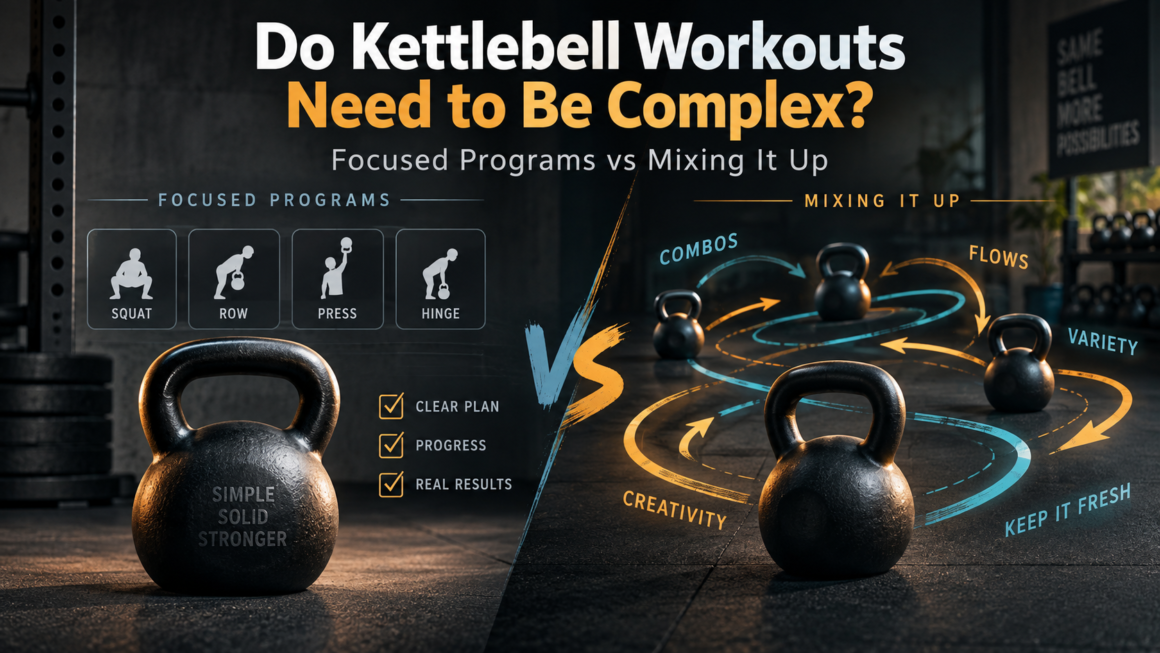

TL;DR: Flows, complexes and combos aren’t required to get results with kettlebells. A simple program built around a squat, row, press and hinge already covers the main movement patterns. If you want a specific result within a set period, a focused program such as ASGARD or FAST IRON will usually serve you better because you repeat and progress the same work. If you want kettlebell training to stay varied and be something you enjoy doing for years, flows, complexes and combos can fit alongside those basics.
Scroll through kettlebell content online and you’ll see flows, complexes and combos everywhere, along with plenty of people arguing that you don’t need any of them. They’re right in one sense: you can get stronger and fitter with a kettlebell squat, row, press, and a hinge such as a deadlift or swing. But that doesn’t make the other stuff pointless. Whether it belongs in your training depends on what you actually want from the training. If you have a specific result to achieve within a set period, sticking closely to a few exercises usually makes more sense. If kettlebell training is something you want to keep doing as part of your life, and you value variety, agility and coordination as well as strength and fitness, there’s a good case for mixing things up.
Kettlebell complexes, flows and combos: three choices that get mixed up
When people ask whether kettlebell training needs to be complex, they’re often talking about several different things at once. Exercise difficulty is one of them, how exercises are arranged is another, and how long you stay with the same program is a third. Those choices can overlap, but they are not the same thing, and separating them makes the whole discussion much easier.
The first is simply how difficult the exercise itself is. A goblet squat takes relatively little skill compared with kettlebell juggling, but that has nothing to do with whether the workout is a complex, a flow, a combo or a straight-set session. You can build a very simple workout from difficult exercises, or a more involved sequence from basic ones. Difficulty describes the exercise; it doesn’t describe the way the training is organised.
The second choice is arrangement: how the exercises are put together. With straight sets, you finish the reps of one exercise, put the kettlebell down, rest, and move on. You can also link exercises without putting the kettlebell down. In a kettlebell complex, you do several reps of one exercise before moving to the next, for example, 6 cleans, then 6 swings, then 6 presses. In a kettlebell flow, you usually do one rep of each exercise and move continuously from one into the next. A combo is a fixed sequence performed as one unit. ASGARD, which comes up later, is built around one of ours.
The third choice is focus: how long you stay with the same plan. A focused program repeats and progresses the same work for a set number of weeks, while a varied routine changes more regularly. These choices are independent of each other. Six cleans, 6 swings, and 6 presses can make a complex even though every exercise in it is basic; a focused program can be built around a combo; and a varied routine can use nothing but basic exercises. The rest of this article is mainly about that third choice, because focus has the biggest influence on what you’re actually training toward.
When a focused kettlebell program is the better choice
The body adapts to the demands you repeatedly place on it, so program design starts with the training goal and the other choices follow from there. A focused program makes that straightforward: choose a target, repeat the same kettlebell exercises long enough to improve them, and add load, reps or speed in planned steps. Because the work stays recognisable from week to week, progress is easier to measure. If you use the same test at the start and end of the program, you have something concrete to compare.
That approach obviously suits an athlete preparing for a sport or event, where training has to serve a specific outcome, but it isn’t only for competitors. It also suits someone training at home who wants a serious result within a set period and is willing to follow the plan closely instead of changing the session every time they get bored.
Two of our programs are built this way. ASGARD is a 6-week double-kettlebell program built around one full-body combo, with routes for strength, endurance, cardio or all three and a benchmark that is repeated to measure progress. It uses a combo and develops broad capability, but it is still focused: the same combo is progressed on purpose for 6 weeks. FAST IRON takes a different route. It is an 8-week double-kettlebell program for building muscle while keeping speed, using basic exercises – a squat, row, press and chest press – performed fast on the way up and slow on the way down, followed by a re-test at the end.
When mixing up your kettlebell workouts makes more sense
Most people training at home are not preparing for a competition. They want to be strong enough, mobile, agile, quick on their feet and able to handle whatever everyday life throws at them, not just for the next 6 or 8 weeks but for years. When the goal is that broad, adherence matters enormously. A perfectly designed program does very little for someone who gets bored with it and stops training.
There is some evidence that variety can help. In a 6-week study of physically inactive adults, those given a more varied program stuck to it better than those given a less varied one, and the difference was linked to how varied the program felt to them. In trained men, randomly varying exercises every session produced similar strength and muscle gains to a fixed program over 8 weeks, while motivation to train increased more in the varied group. Both studies were small and short, so they are useful support for the idea rather than proof that more variety is always better.
Variety also changes what the body has to deal with. Kettlebell flows and complexes can introduce more transitions between positions, more changes of direction and more coordination under load than straight sets built around a small number of basics. If being nimble and adaptable matters to you, there is a good reason to practise a wider range of positions and speeds instead of treating every session as a test of the same few movements.
This is how we tend to program kettlebell training for most people outside a focused block. Harder sessions are balanced with active recovery sessions that usually include mobility and stretching, so the work people often skip is already part of the plan instead of being left for “if there’s time.”
The downsides of focused programs and varied kettlebell workouts
Neither approach gets a free pass. A focused kettlebell program can become boring, and boredom is one reason people stop following a routine. It also narrows what you practise. Six weeks of the same combo should make you better at that combo and at the qualities it trains, but during those six weeks you are spending less time on everything outside it. For a focused block, that is not a flaw; it is the point. As a permanent way of training, though, it can leave gaps.
Mixing it up has its own problems. Progress becomes harder to measure when the work keeps changing, and skill-heavy exercises or complicated arrangements have to be learned before they can be trained hard. At IKU™ we separate learning, training and working out because they are not the same thing. Learning means practising an exercise to build the movement while you are fresh, using low reps and a weight light enough that the movement does not change. Training means using an exercise you already own to develop strength, power or endurance on purpose, with more load, volume or fatigue. Working out is a session for its own sake, without a specific learning goal or planned adaptation.
That distinction matters with flows and complexes. A flow you have not learned yet belongs in learning, not in a hard timed session. If you perform it for time while tired before you own the movements, you are not just getting more reps; you are also rehearsing whatever happens to your technique under fatigue. No number of reps is worth a rep that has changed.
If you are unsure whether a new flow or complex is ready to move from learning into training, you can post a video for a free form check through CONNECT, where a certified IKU™ coach reviews your form and technique.
How to choose between a focused program and a varied routine
Start with what you want from the next block of training. If you have a specific result in mind, a date to be ready by or a number you want to hit, run a focused program for its full length and measure what happened at the end. If your main goal is to make kettlebell training part of your life, keep the basics in place but allow yourself more variety. There is no universal winner here; the better choice depends on the job you need the training to do.
You also do not have to choose one approach for life. A practical way to combine them is to train with more variety for much of the year, then run a focused block when you have a particular goal or feel that progress has stalled. ASGARD’s 6 weeks or FAST IRON’s 8 weeks fit that model well. When the block ends, return to broader training and keep what you gained. Because both approaches are still built on the same basic movement patterns, time spent in one does not disappear when you switch to the other.
FAQ
Is a simple kettlebell workout with the basic exercises enough?
Yes. The basics are enough to get results, so flows, complexes and combos are not a requirement. Add them when they suit the goal, for example when you want more variety, coordination or agility rather than because you think a kettlebell workout has to look complicated to work.
Are kettlebell flows good for building strength?
They can build some strength, but a flow usually uses one rep of each exercise and the usable weight is limited by the hardest part of the sequence. If maximum strength is the priority, a focused program with straight sets is easier to load progressively and measure. Flows bring other things to the table, particularly coordination, transitions and conditioning.
What’s the difference between a kettlebell complex and a kettlebell flow?
In a complex, you do several reps of one exercise before moving to the next. In a flow, you usually do one rep of each exercise and move continuously from one into the next. In both cases, the kettlebell stays in your hands until the sequence ends.
How long should I run a focused kettlebell program?
Run it for the full length it was designed for, then re-test. ASGARD runs for 6 weeks and FAST IRON for 8.
Can beginners do kettlebell complexes?
Yes, provided the complex is made from exercises they have already learned. Learn each movement on its own first, then start linking them. The arrangement can become more complex only after the individual exercises are stable.
References
- Kraemer WJ, Ratamess NA. Fundamentals of resistance training: progression and exercise prescription. Med Sci Sports Exerc. 2004;36(4):674–688. https://doi.org/10.1249/01.mss.0000121945.36635.61
- Sylvester BD, Standage M, McEwan D, et al. Variety support and exercise adherence behavior: experimental and mediating effects. J Behav Med. 2016;39(2):214–224. https://doi.org/10.1007/s10865-015-9688-4
- Baz-Valle E, Schoenfeld BJ, Torres-Unda J, Santos-Concejero J, Balsalobre-Fernández C. The effects of exercise variation in muscle thickness, maximal strength and motivation in resistance trained men. PLoS One. 2019;14(12):e0226989. https://doi.org/10.1371/journal.pone.0226989
- Workouts
- Courses
- Certifications
- Coaches
- Live feed

