


Steve Cotter, a two-leaflet valve, and what people assume when a fit man’s heart fails.
The question nobody could answer
Steve Cotter died on 16 January 2025, one day before his 55th birthday. Heart attack. If you have trained with kettlebells for any length of time you know the name: founder of the IKFF, one of the first people to put kettlebell technique on video for the West, a man who could do a pistol squat holding two kettlebells and make it look like a warm-up.
Within a day the community was asking how. How does someone who breathes health and fitness die at 54? I asked it too. I made a video, posted it in the kettlebell groups, and the replies showed me everybody had the same question and nobody had the answer.
What people did have was a theory. The theory that shows up every time a fit person dies suddenly: it must have been the covid vaccine. I knew Steve. We had spoken about these things, at arm’s length, the way you do with someone you respect but don’t see often. I can’t repeat what he said, but I am confident that he was not a man who would have taken it. So that theory, in his case, has nothing behind it. It still travelled further than any other.
I am writing this because if I die before my operation, people will say the same thing about me. I don’t blame them. I would think it too.
For the record
I never took the covid vaccine. I spent my life savings avoiding it. When the certificates came in we were living in Italy; we left for Tanzania, then Albania, because I was not going to be forced into something I had not chosen. Whatever you think of that decision, it was mine and I paid for it. I want that written down in my own words, so that nobody has to guess.
Because the other thing people will say, if a man who spent his life on health and fitness drops dead, is that he must have done something wrong. He ate badly. He drank (I do, but that’s not the cause). He pushed too hard. He hid something. I know they will say it, because I would have said it myself.
Twelve burpees
This all happened in the first half of 2026. The first time was twelve burpees. Twelve is nothing for me, it’s what I do. At the end of them I could not breathe and I could not speak. I was on the floor and I was sure I was dying. I held my hand out to my wife because if this was it, I wanted to be holding her hand. She thought I was joking. It got awkward. Then it passed, and I got up, and I ignored it.
The second time I came home from a bicycle ride, nothing strenuous, and I was not there. I kept asking my wife the same things, over and over, and could not hold the answers. Looking back, I think my brain was simply not getting enough blood.
The third time I jogged 20 metres and nearly fainted. I had to sit for ten minutes before I could stand. That was when my wife said we were going to see someone.
I’m putting all three in order because I want you to see what I did with the first two. I recovered, and I filed them under “one of those things.” A reader who trains hard would do the same. That’s the point of this article.
What the cardiologist said
Severe aortic stenosis. A dilated ascending aorta, 46 millimetres. Two doctors, because something like this needs two opinions, and both said the same thing: do not lift weight again until this is repaired.
That is why I stopped kettlebell training. Or, to be honest, why I’m trying to. I still post videos with simple exercises that could put me out of action afterwards. I still train with light weight, and sometimes I experiment with heavy, as long as I’m not exhausting the heart. My wife tells me off. It’s my choice, I make it, and I know what can happen.
When you hear “severe” and “aorta” and “46mm” in one sentence, your world changes shape. I did not sleep for many nights. We cried a lot. We talked a lot, because there are arrangements to be made when you are 52, heading on to 53, and a surgeon is going to open your chest.
I thought I had earned a healthy heart
Here is the part I want you to sit with, because it’s the part I had wrong.
I believed heart problems were something you earned. Smoking, drinking, bad food, no training, that’s how you got there. I had not lived a perfect youth, but at some point I got wise, changed, and built a life around getting it right. I was, according to every doctor I have seen, in excellent health apart from the thing they had just found. So I was exempt. Heart disease was for other people, and if it ever came for me, I would deserve it, because it would mean I had not lived the way I claimed to.
Then the cardiologist told me the problem was the number of leaflets on a valve I was born with. The irony of being hardly ever sick and then having this.
What a bicuspid valve actually is
A normal aortic valve has three leaflets that open like a three-way door and share the load evenly. Mine has two. Every heartbeat, about 100,000 times a day, those two leaflets get bent further than they were designed for, and the blood has to squeeze through a smaller, more turbulent opening.
Tissue that is repeatedly stressed and injured responds by thickening and laying down calcium, the same way skin thickens into a callus. On a normal valve that process takes so long that it shows up in the 70s and 80s, if at all. On a two-leaflet valve it shows up 20 to 30 years earlier, which is why bicuspid patients typically land in surgery in their 50s. I’m 53.
The 46mm aorta is the second half of the same story. The bicuspid condition also comes with a weaker aortic wall, and the jet of blood forced through the narrow valve hits that wall at higher velocity. Both push it to widen over decades. Dilation and aneurysm are the same process with different labels; most surgeons start using the second word somewhere around 45 to 50 millimetres, and at that size they replace the section of aorta while they are replacing the valve.
Roughly one to two people in every hundred are born with a bicuspid valve. Most of them do not know, because it makes no noise until it does, and healthy people do not get echocardiograms.
So did my lifestyle matter? Yes, and not in the way I had it framed. Cholesterol, blood pressure and smoking speed up valve calcification. By keeping those in check for decades I very likely bought myself years. What I could not do was remove the cause, because the cause was a part that was made wrong before I took my first breath. A fit body can carry that for fifty years without a sign. I don’t know what Steve had. Nobody has said. But the question people asked about him rested on the same assumption I had about myself, and I now know that assumption is wrong.
Why the burpees nearly killed me
With a valve this narrow, the heart can push enough blood through for sitting, walking, even a bicycle ride at an easy pace. When you demand more, the valve cannot open wider to give it, so blood pressure drops and the brain goes short. That is the breathlessness after twelve burpees, the confusion after the bike, the near-faint after 20 metres of jogging. The textbooks list those as the warning signs of severe stenosis. I had all three and got up each time.
That is also why the doctors said no weight. Heavy effort spikes blood pressure and load on the aortic wall, and a 46mm aorta under that spike can tear. A dissection at home, with a kettlebell in your hand, is one of the ways a fit man in his fifties dies suddenly.
The strange calm
After a few weeks I stopped thinking about it. I stopped thinking about dying. And I feel much better.
I am barely training. I am eating and drinking too much. When my wife does her kettlebell session I feel sad watching. And still, right now, I feel like I could snatch a 36kg kettlebell. I am not going to. But that is how I feel, and I want you to understand how dangerous that feeling is.
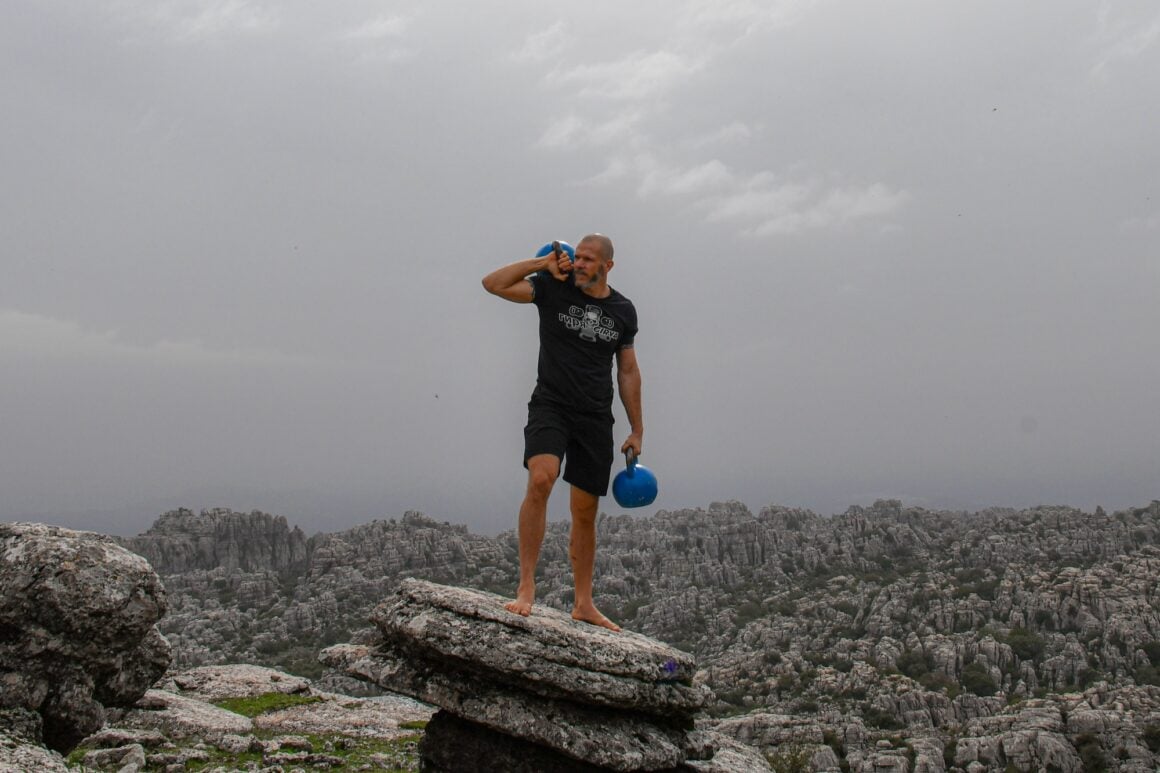
Nothing has changed inside my chest. The valve is exactly as narrow as it was on the floor after the burpees. What changed is that I stopped provoking it. Severe stenosis feels like nothing at all if you don’t ask your heart for anything, and the relief you get from feeling normal again is the thing most likely to make you put off the operation. Exertional fainting in severe stenosis is one of the findings that moves surgery from “soon” to “as soon as possible.” Feeling good in between is expected, and it tells you nothing about the valve.
What comes next
The operation, when it comes. As I write this, mid 2026, nothing is scheduled. I am in limbo between the diagnosis and a date, which is its own kind of waiting. When it does happen, the valve gets replaced and the widened section of aorta with it. The options are a mechanical valve with a graft, a tissue valve, or the Ross procedure, where your own pulmonary valve is moved into the aortic position and a donor valve takes its place. Most of what I have read points to Ross for someone who wants to train again. It is not available to me. I am on Greek public insurance (EFKA/AMKA), and Ross would cost at least another 20,000 euro on top, money I do not have. So it will be one of the other two, and I will write about that decision when it’s made.
After the repair, the plan is to train with weight again. Not tomorrow, and probably not the way I did, but the restriction I’m under now is until the aorta is fixed, not for life. I want that clear, because I have no intention of quitting.
What I would tell you
If you are fit, eat well, don’t smoke, train hard, and think heart disease is for other people: I thought that too. One in fifty of us has a valve that will fail early, and the first sign can be a fainting episode during exercise that you will be tempted to shake off.
If you have ever nearly passed out during effort and recovered, do not file it away. Tell a cardiologist exactly what happened.
If you have never had an echocardiogram, and especially if a parent or sibling had a valve or aorta problem, get one. It takes twenty minutes and it would have found mine at any point in the last thirty years. With that said, I think it has suited me not knowing until now.
And when the next fit person dies suddenly, before you reach for the easy theory, remember that some of us carry a defect we never chose, and lived well anyway.
Either way, if I don’t make it, I regret one thing only. I regret giving my son a computer, and later a PlayStation. It took the time we should have had together, the outings, the bonding, and turned into something he could not put down and could not stop thinking about. Everything else, I had an awesome life. I lived it to the fullest, I still want more of it, and if it is so, it is so.
Steve, I still don’t know what happened to you. I hope someone who does will say. Miss you buddy.

References
- Siu SC, Silversides CK. Bicuspid aortic valve disease. Journal of the American College of Cardiology, 2010.
- Michelena HI et al. Bicuspid aortic valve: identifying knowledge gaps and rising to the challenge. Circulation, 2014.
- Vahanian A et al. 2021 ESC/EACTS Guidelines for the management of valvular heart disease. European Heart Journal, 2022.
- Otto CM et al. 2020 ACC/AHA Guideline for the management of patients with valvular heart disease. Circulation, 2021.
- Pelliccia A et al. 2020 ESC Guidelines on sports cardiology and exercise in patients with cardiovascular disease. European Heart Journal, 2021.
- Mazine A et al. Ross procedure in adults for cardiologists and cardiac surgeons. Journal of the American College of Cardiology, 2018.
- Workouts
- Courses
- Certifications
- Coaches
- Live feed

