

Ask which is better, a dumbbell or a kettlebell, and what you usually get is an argument. Most of it comes from people defending the tool they already own.
There is a simpler way to look at it. The two are built to different shapes, and where the weight sits relative to your hand decides which one suits a given exercise more easily. Both tools do more than people give them credit for, so the useful question is which one makes a given job less awkward.
This article covers full dumbbell routines you can run as written, where a kettlebell suits the work better, and what the research does and does not support about resistance training in general.
Where the Weight Sits
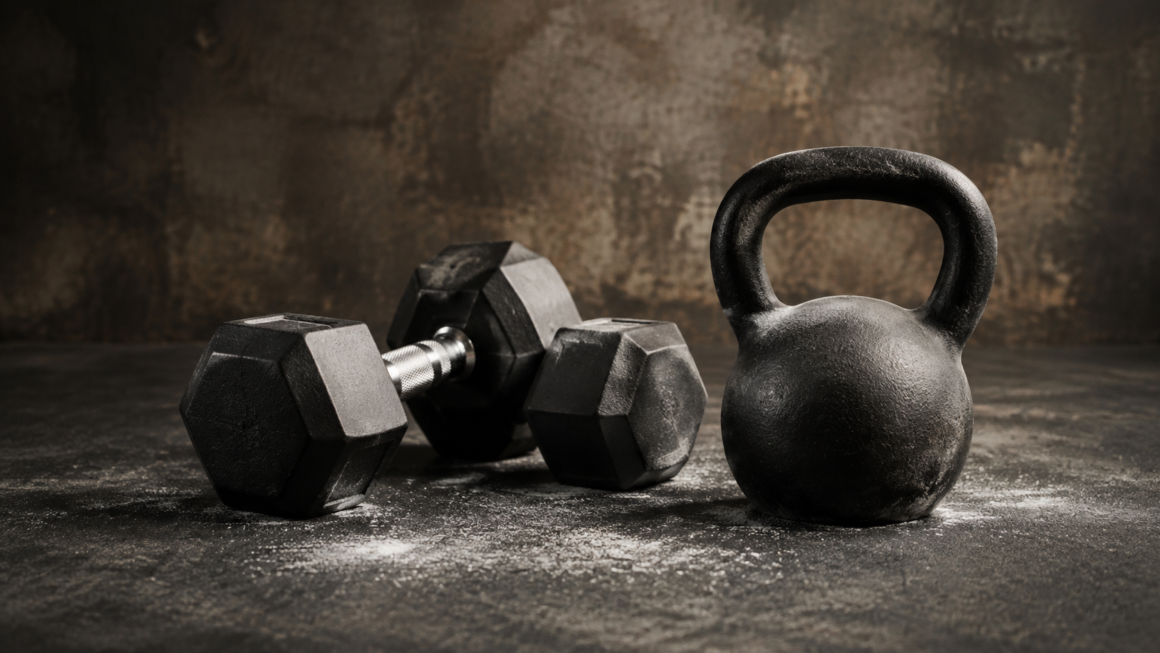
A dumbbell carries its mass on either side of your hand, in line with the grip. A kettlebell hangs its mass under and slightly forward of the fist, on a handle wide enough for the weight to swing around your hand and settle against the back of your forearm.
That is the whole physical difference between them, and most of the practical differences follow from it.
Two things it does not change. The rack position is the same with either tool: the arm holds the same shape, and only the location of the load along it differs. A dumbbell racked at the shoulder is a working position you can hold, breathe in, and cycle from, the same as a kettlebell in the rack. And neither tool is locked out of any category of exercise. You can swing, clean and snatch a dumbbell.
What it does change is how much friction you meet doing certain things, and where the load presses on you when you do. The forearm contact that comes with kettlebell racking is its own skill, and getting it wrong is the most common source of forearm bruising and pain in new trainees.
What Each Tool Suits
Ballistics. A kettlebell suits these more easily. The handle lets the mass pass between the legs at the bottom of a swing and travel around the hand on the way up, so the movement cycles with less interruption. You can run the same exercises with a dumbbell, and there is a dumbbell swing in one of the circuits further down this article. The kettlebell swing is the exercise worth learning properly first if you have both tools available, because the timing carries over to the clean and the snatch.
Overhead work. A kettlebell puts the mass behind the wrist rather than in line with the arm, which changes what the shoulder and trunk have to do to keep it stacked. Presses, jerks and the overhead phase of a get-up all feel different for that reason.
Wrist rotations, scarecrows and mobility work. A dumbbell suits these better. The load sits in line with the hand instead of hanging off it, so you can rotate and position the weight without fighting an offset mass.
Isolation and bilateral pressing. A dumbbell, for the same reason. Curls, lateral raises, incline press, flyes and rows all benefit from a balanced load that lets you tax the target muscle without paying a grip and wrist tax first.
Everything else. Goblet squats, split squats, loaded carries and most pressing go either way. If you have one tool and not the other, use the one you have.
Complete Body Dumbbell Routine
A well-designed total body dumbbell workout covers all the major movement patterns and lets you address left-to-right differences, since each side has to do its own work.
- Goblet Squats: hold one dumbbell vertically at chest height. 3 sets of 10 to 12. Promotes an upright torso and engages the anterior core.
- Romanian Deadlifts: feet hip-width apart, dumbbells at thigh level. Hinge at the hips maintaining a neutral spine. 3 sets of 10.
- Floor Press: lie on the floor with dumbbells at chest level. Press up, pause at the top. 3 sets of 10. The floor gives a natural stopping point.
- Single-Arm Overhead Press: press one dumbbell overhead while standing. 3 sets of 8 per side. Unilateral pressing challenges trunk stability and shows up side-to-side differences.
- Three-Point Rows: support yourself on a bench with one hand and row with the other. 3 sets of 10 per side.
Movement quality matters more than load. Control the lowering phase and use the full range you have before adding weight.
A naming note. The Romanian deadlift appears in a few of the routines in this article, and it has been left under the name you will see everywhere else. It is worth knowing that the name does not hold up. The weight never returns to a dead stop, so there is no dead starting condition, which makes it a hang lift that uses a hip hinge. Want to know why the Romanian deadlift is a misnomer? The word has been traced back to the 1550s.
Time-Efficient Training Protocol
When time is short, twenty minutes of compound work still gives you a training stimulus worth having.
- Dumbbell Thrusters: front squat into an overhead press. 3 sets of 10.
- Renegade Rows: plank position on the dumbbells, rowing one side at a time. 3 sets of 8 per arm.
- Reverse Lunges: step backward holding dumbbells at your sides. 3 sets of 10 per leg.
- Floor Press to Fly: alternate pressing and fly movements. 3 sets of 12 total.
- Farmer’s Carry: walk with heavy dumbbells at your sides for 40 seconds, rest 20, repeat 3 times.
Keep rest to 45 to 60 seconds between sets to hold the heart rate up.
Three of these transfer straight across to kettlebells with no change in intent: the thruster, the reverse lunge and the carry. The renegade row is the one that changes character, because a kettlebell handle sits higher off the floor and the base is narrower, so the plank is less stable before you have rowed anything.
Movement Quality and Injury Prevention
Poor movement under load accumulates. Establishing the pattern first is what makes the load useful later.
- Spinal position: keep your natural spinal curves through the movement.
- Controlled tempo: lower over 2 to 3 seconds, pause, then lift with control.
- Full range of motion: move through the complete range you have, unless a mobility limitation or injury says otherwise.
- Breathing: exhale on the effort, inhale on the easier phase. Do not hold your breath through repetitions.
Start with weights that let you keep all four of those for every prescribed repetition. Adding load before the pattern is established means you are practising it under load.
Circuit Training for Conditioning
Moving quickly between exercises with minimal rest keeps the heart rate up while you accumulate volume.
- Goblet Squats: 12 reps
- Push-Ups on Dumbbells: 10 reps
- Single-Leg Romanian Deadlifts: 8 reps per leg
- Bent-Over Rows: 10 reps
- Overhead Press: 10 reps
- Russian Twists: 15 reps per side
- Dumbbell Swings: 15 reps
Move through all seven with 15 to 20 seconds between exercises. Rest 90 to 120 seconds, then repeat for 3 to 4 rounds.
Programming for Hypertrophy
- Progressive overload: increase the stress over time through load, repetitions or sets.
- Volume: 10 to 20 sets per muscle group per week, spread across 2 to 3 sessions.
- Exercise variation: rotate exercises every 4 to 6 weeks.
- Time under tension: control the tempo so sets last 40 to 60 seconds.
A sample session:
- Bulgarian Split Squats: 4 sets of 8 to 10 per leg
- Incline Dumbbell Press: 4 sets of 8 to 10
- Single-Arm Rows: 4 sets of 10 to 12 per side
- Lateral Raises: 3 sets of 12 to 15
- Romanian Deadlifts: 3 sets of 10 to 12
- Hammer Curls: 3 sets of 10 to 12
- Overhead Tricep Extensions: 3 sets of 10 to 12
Rest 60 to 90 seconds between sets and train to within 1 to 2 repetitions of failure on most of them.
What Resistance Training Actually Does
Articles like this one usually open with a list of health benefits that nobody sources. Here is what the research supports, and where it is thinner than the usual list suggests.
Blood pressure. This one holds. A meta-analysis pooling 93 trials and 5,223 participants found dynamic resistance training lowered diastolic pressure by around 3 mmHg, with the largest systolic reductions in people whose pressure was already above normal but not yet hypertensive, at around 4 mmHg.¹
Arterial stiffness. This is less settled than most articles suggest. One meta-analysis found low-to-moderate intensity resistance exercise improves it.² Other reviews have found no reduction in middle-aged adults, and there is an open question about whether high-intensity work makes it worse. Treat this as unresolved rather than as a benefit to bank on.
Bone density. Supported, with a limit worth naming. A meta-analysis of 17 randomised trials in 690 postmenopausal women found resistance training improved bone density at the lumbar spine and femoral neck.³ The LIFTMOR trial improved lumbar spine density by around 4% over eight months compared to a low-intensity control, with adherence above 90%.⁴ What none of these trials show is a reduction in fractures. They are not designed or powered to measure that, so anyone telling you resistance training prevents broken bones is going further than the evidence does.
Metabolism. The claim that building muscle raises your resting metabolism is true and much smaller than it sounds. Tissue-specific metabolic rates used in this literature put skeletal muscle at roughly 13 kcal per kg per day, against 240 for the brain and 440 for the heart and kidneys.⁵ The average muscle gain across resistance training studies is about 1.5 kg,⁶ which works out at roughly 20 kcal a day. A systematic review of exercise interventions found no significant increase in resting metabolic rate at all.⁷ Strength and muscle are worth training for on their own merits. The effect on your resting burn is a rounding error.
Mood. The outcome is supported. The usual explanation for it is not. Meta-analyses of randomised trials found resistance training reduced depressive symptoms⁸ and anxiety symptoms.⁹ The endorphin-and-cortisol mechanism you see quoted everywhere is proposed in the literature rather than demonstrated. The effect itself is well evidenced, and the mechanism behind it is still being worked out.
Where to Go for Each Half
If the kettlebell half of this is what interests you, the Cavemantraining list of over 400 kettlebell exercises has tutorials and video for each one, and it is the fastest way to find the kettlebell equivalent of anything in the routines above. If you want someone qualified to look at your technique, post a video through CONNECT free coaching and a certified IKU™ coach will review it with notes pinned to the point where the movement breaks down.
For the dumbbell half, a kettlebell site is not the right source. Cavemantraining™ is a kettlebell site and has no plans to build a dumbbell library. Routines like the one above are the whole of what dumbbells.com does. It is a blog rather than a store, split into workouts, equipment reviews and an educational section, so if you want another total body dumbbell workout built along the same lines, or want to put your own together, that is where to look.
References
- Cornelissen VA, Smart NA. Exercise training for blood pressure: a systematic review and meta-analysis. J Am Heart Assoc. 2013;2(1):e004473. https://doi.org/10.1161/JAHA.112.004473
- Low-to-Moderate-Intensity Resistance Exercise Effectively Improves Arterial Stiffness in Adults. Front Cardiovasc Med. 2021;8:738489. https://doi.org/10.3389/fcvm.2021.738489
- Optimal resistance training parameters for improving bone mineral density in postmenopausal women: a systematic review and meta-analysis. J Orthop Surg Res. 2025. https://doi.org/10.1186/s13018-025-05890-1
- Watson SL, Weeks BK, Weis LJ, Harding AT, Horan SA, Beck BR. High-intensity resistance and impact training improves bone mineral density and physical function in postmenopausal women with osteopenia and osteoporosis: the LIFTMOR randomized controlled trial. J Bone Miner Res. 2018;33(2):211–220. https://doi.org/10.1002/jbmr.3284
- Wang Z, Ying Z, Bosy-Westphal A, Zhang J, Schautz B, Later W, et al. Specific metabolic rates of major organs and tissues across adulthood: evaluation by mechanistic model of resting energy expenditure. Am J Clin Nutr. 2010;92(6):1369–1377. https://doi.org/10.3945/ajcn.2010.29885
- A Systematic Review with Meta-Analysis of the Effect of Resistance Training on Whole-Body Muscle Growth in Healthy Adult Males. Int J Environ Res Public Health. 2020;17(4):1285. https://doi.org/10.3390/ijerph17041285
- The effect of exercise interventions on resting metabolic rate: a systematic review and meta-analysis. https://pubmed.ncbi.nlm.nih.gov/32397898/
- Gordon BR, McDowell CP, Hallgren M, Meyer JD, Lyons M, Herring MP. Association of efficacy of resistance exercise training with depressive symptoms. JAMA Psychiatry. 2018;75(6):566–576. https://doi.org/10.1001/jamapsychiatry.2018.0572
- Gordon BR, McDowell CP, Lyons M, Herring MP. The effects of resistance exercise training on anxiety: a meta-analysis and meta-regression analysis of randomized controlled trials. Sports Med. 2017;47(12):2521–2532. https://doi.org/10.1007/s40279-017-0769-0
- Workouts
- Courses
- Certifications
- Coaches
- Live feed

