
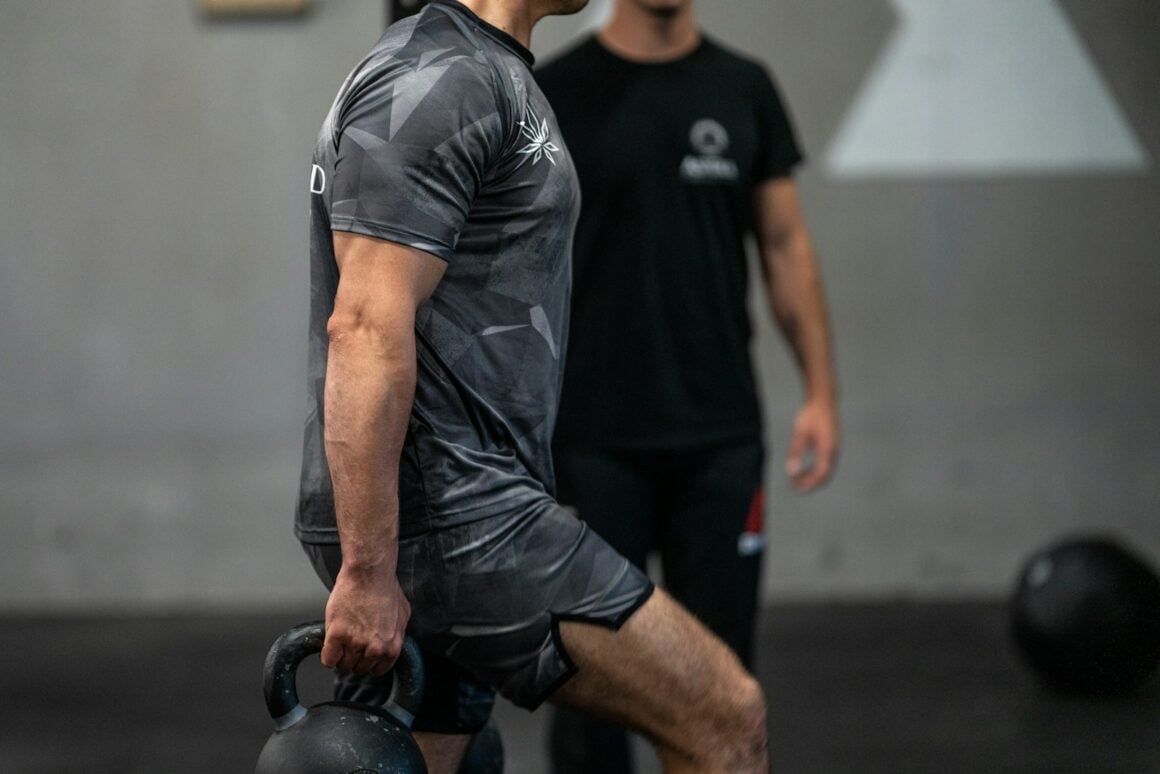

You step on the scale and see the number drop, but when you look in the mirror, you don’t see the athletic definition you were hoping for. Aiming simply to lose weight is often the wrong goal if you’re after a strong physique. Body recomposition shifts the focus to what that weight is made of. One way to shed fat while holding onto hard-earned muscle is to combine kettlebell ballistics with a dialed-in protein intake.
Body Recomposition Is Better Than Traditional Weight Loss
Body recomposition involves losing body fat while maintaining or adding muscle tissue. Cutting calories without training tends to take muscle along with the fat, because the body draws on both when it’s short of energy.
Resistance training changes that. In a study of 304 adults following a diet designed to create a deficit of about 500 calories a day, the people who did resistance training lost the most fat and were the only group to gain fat-free mass, while the group that did no exercise lost it.¹ Participants chose their own exercise and the study looked back at their results, so it shows an association rather than proving cause. It fits a consistent pattern, though: a moderate deficit combined with resistance training changes what your weight loss is made of, so you don’t have to starve to get leaner.
Holding onto muscle matters for strength, for how you move and for how you look. It isn’t a big metabolic lever, which is worth knowing. Skeletal muscle burns roughly 13 calories per kilogram per day at rest,² so a few kilograms of extra muscle add up to a few dozen calories a day. Protect your muscle for what it lets you do. The extra calories it burns at rest are small.
The Kettlebell Advantage for Fat Loss
Kettlebell training bridges the gap between heavy resistance training and hard conditioning work. The main difference from a dumbbell is where the weight sits. A kettlebell’s mass hangs below and slightly in front of the handle, which lets it travel between your legs and swing up in front of you. That makes explosive exercises like swings, cleans and snatches flow more easily with a kettlebell, although you can do most of them with a dumbbell too.
Kettlebells also scale well. They come in sizes from 4 kg up to 48 kg and beyond, so there is a starting point and a next step whatever your training level.
Why Kettlebell Ballistics Deliver Great Results
Unlike slow, grinding exercises like a heavy barbell squat, kettlebell ballistics are explosive, dynamic movements. They include swings, snatches and cleans, which work well for body recomposition.
These exercises combine loaded hip extension with a sustained high heart rate. In one study, ten men doing two-handed hip hinge swings with a 16 kg kettlebell for 12 minutes averaged 87% of their maximum heart rate and about 65% of their maximum oxygen uptake.³ That’s a real training stimulus in a short session. Calorie figures quoted for swings vary enormously, though, so it’s worth checking how many calories kettlebell swings actually burn before building your diet around an estimate.
Swings, cleans and snatches also make your muscles contract hard against the load on every repetition. That’s why they sit comfortably alongside heavier, slower exercises in a recomposition program rather than replacing them.
Structuring Your Weekly Sessions
You don’t need to train six days a week to see meaningful changes. Three to four focused, high-effort kettlebell sessions per week is a workable schedule for most people pursuing recomposition.
When some people enter a caloric deficit to lose fat, they drop their training volume or switch to lighter weights. That instinct deserves some caution. A review of resistance-trained athletes in caloric restriction found that studies keeping volume high, or increasing it over time, tended to show little or no lean mass loss. The authors were careful to add that the evidence wasn’t strong enough to conclude higher volume is definitely better.⁴ A later trial by the same research group then found that high and moderate volume preserved lean mass equally well during a deficit.⁵ In practice, that means keeping your training hard and your loads up, without needing to pile on extra volume to protect your muscle.
Consider structuring workouts with a mix of heavy, low-rep sets for strength. Then, add higher-rep ballistic intervals for conditioning.
The Role of Protein in the Recomp Equation
Without the right fuel, even the best workout routine will fall flat. When the body takes in less energy than it burns, it draws on its own tissues to make up the difference.
Adequate protein helps protect lean muscle during a deficit. Meta-analyses of tightly controlled feeding studies have found greater fat loss and better preservation of lean mass on higher-protein diets during energy restriction.⁶ Protein also has a modest effect on fullness. People report feeling fuller after higher-protein meals, although that hasn’t been shown to reduce how much they eat at their next meal.⁶
How Much Do You Actually Need?
If you’re training hard with kettlebells and trying to lose fat, aim for intake well above the bare minimum. The 2025–2030 Dietary Guidelines for Americans, which introduced the new inverted food pyramid, set a general target of 1.2 to 1.6 grams of protein per kilogram of body weight per day, which is a useful starting point. For a plain-language rundown of what changed in the new food pyramid, Feesers has a useful summary. Some people will need more depending on training volume, body composition and the size of their calorie deficit. Reviews aimed at resistance-trained athletes in a fat loss phase suggest higher intakes still.⁷
Timing Nutrition Around Your Training
There’s no need to chug a protein shake within five minutes of finishing a kettlebell session. Total daily protein intake matters more than the exact moment it’s consumed.
Spread your protein across three to four meals rather than loading most of it into one. A review of fat loss strategies for resistance-trained athletes suggests roughly 0.4 to 0.55 grams per kilogram of body weight at each meal, with one of those meals within a few hours either side of training.⁷
Beyond the hours surrounding a workout, look at the big picture of your training week. One option is to vary your calorie intake with your activity. In a seven-week trial with resistance-trained men and women, a group that ate more carbohydrate on two consecutive days each week and dieted on the other five lost less fat-free mass than a group on a continuous deficit.⁸ Eating slightly more on heavy kettlebell days, including complex carbohydrates like brown rice and quinoa, gives you the energy to train hard.
On rest days, you can lower your calorie intake while keeping your protein high, maintaining a modest deficit that drives fat loss without undermining your training.
Sample Kettlebell Training Protocols to Put Into Action
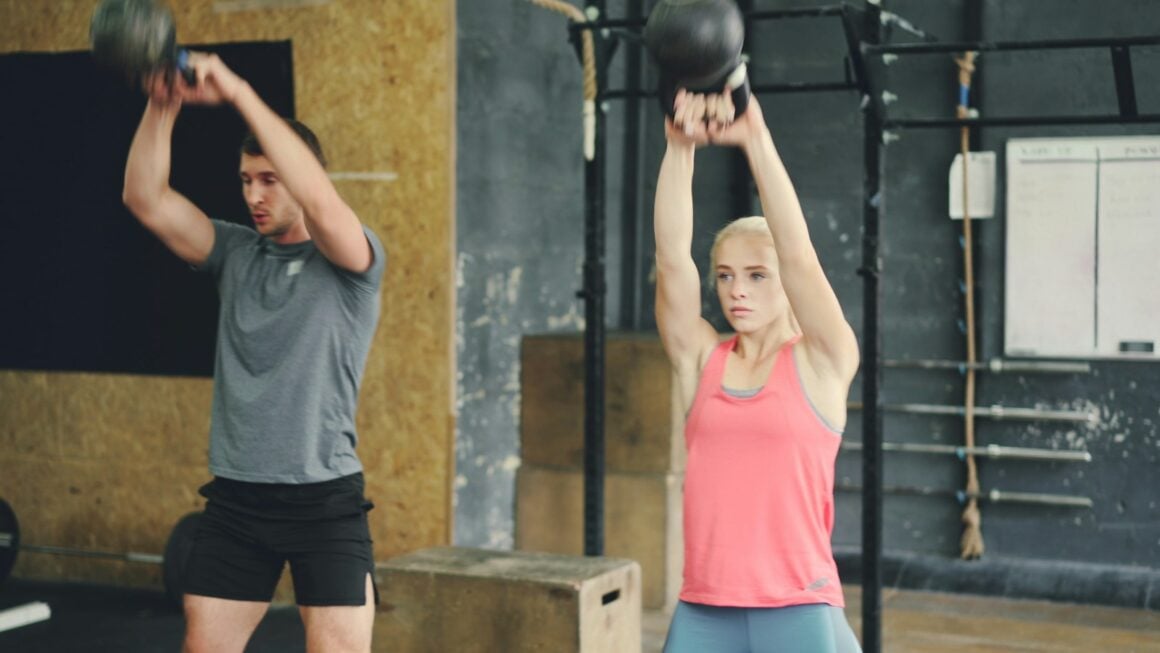
Combine kettlebell ballistics with the protein guidelines above to create a training plan. A sample training split can look like this:
- Monday: Heavy two-handed hip hinge swings and goblet squats
- Wednesday: Kettlebell cleans, presses and core stability work
- Friday: High-intensity kettlebell snatch intervals
Pair this workout schedule with a sustainable nutrition plan. Instead of drastically cutting your calories, take a moderate approach. A review of fat loss in resistance-trained athletes recommends aiming to lose around 0.5 to 1.0% of your body weight per week to hold onto as much fat-free mass as possible.⁷ Lose weight faster than that and a larger share of it is more likely to come from muscle.
Real Talk on Consistency and Recomp Reality
While body recomposition is effective, it’s not an overnight fix. It’s a biological process that takes time, patience and repetition. Don’t judge your progress on the scale alone. It can be misleading during a recomp phase, given that muscle is denser than fat. The number could stay the same while your clothes fit more loosely and your muscles look more defined.
Your training numbers tell you a lot too. If your swing weight, your clean and press numbers and your snatch totals are going up while your waist measurement comes down, the recomposition is working. Swing kettlebells consistently, prioritize protein and trust the process to achieve your body goals.
Author Bio
With a deep knowledge of workout optimization, Jack Shaw brings his expert opinions and insights to Modded Magazine as lead Fitness editor. His tips, guides and breakdowns have been showcased in publications worldwide, including BarBend, SimpliFaster and TrainHeroic.
References
- Lahav Y, Yavetz R, Gepner Y. Resistance training as a key strategy for high-quality weight loss in men and women. Front Endocrinol. 2026. https://pmc.ncbi.nlm.nih.gov/articles/PMC12851882/
- Wang Z, Ying Z, Bosy-Westphal A, Zhang J, Schautz B, Later W, et al. Specific metabolic rates of major organs and tissues across adulthood: evaluation by mechanistic model of resting energy expenditure. Am J Clin Nutr. 2010;92(6):1369–1377. https://doi.org/10.3945/ajcn.2010.29885
- Farrar RE, Mayhew JL, Koch AJ. Oxygen cost of kettlebell swings. J Strength Cond Res. 2010;24(4):1034–1036. https://doi.org/10.1519/JSC.0b013e3181d15516
- Roth C, Schoenfeld BJ, Behringer M. Lean mass sparing in resistance-trained athletes during caloric restriction: the role of resistance training volume. Eur J Appl Physiol. 2022;122(5):1129–1151. https://doi.org/10.1007/s00421-022-04896-5
- Roth C, Schwiete C, Happ K, Rettenmaier L, Schoenfeld BJ, Behringer M. Resistance training volume does not influence lean mass preservation during energy restriction in trained males. Scand J Med Sci Sports. 2023;33(1):20–35. https://doi.org/10.1111/sms.14237
- Leidy HJ, Clifton PM, Astrup A, Wycherley TP, Westerterp-Plantenga MS, Luscombe-Marsh ND, Woods SC, Mattes RD. The role of protein in weight loss and maintenance. Am J Clin Nutr. 2015;101(6):1320S–1329S. https://doi.org/10.3945/ajcn.114.084038
- Ruiz-Castellano C, Espinar S, Contreras C, Mata F, Aragon AA, Martínez-Sanz JM. Achieving an optimal fat loss phase in resistance-trained athletes: a narrative review. Nutrients. 2021;13(9):3255. https://doi.org/10.3390/nu13093255
- Campbell BI, Aguilar D, Colenso-Semple LM, Hartke K, Fleming AR, Fox CD, et al. Intermittent energy restriction attenuates the loss of fat free mass in resistance trained individuals. A randomized controlled trial. J Funct Morphol Kinesiol. 2020;5(1):19. https://doi.org/10.3390/jfmk5010019
- Workouts
- Courses
- Certifications
- Coaches
- Live feed

