
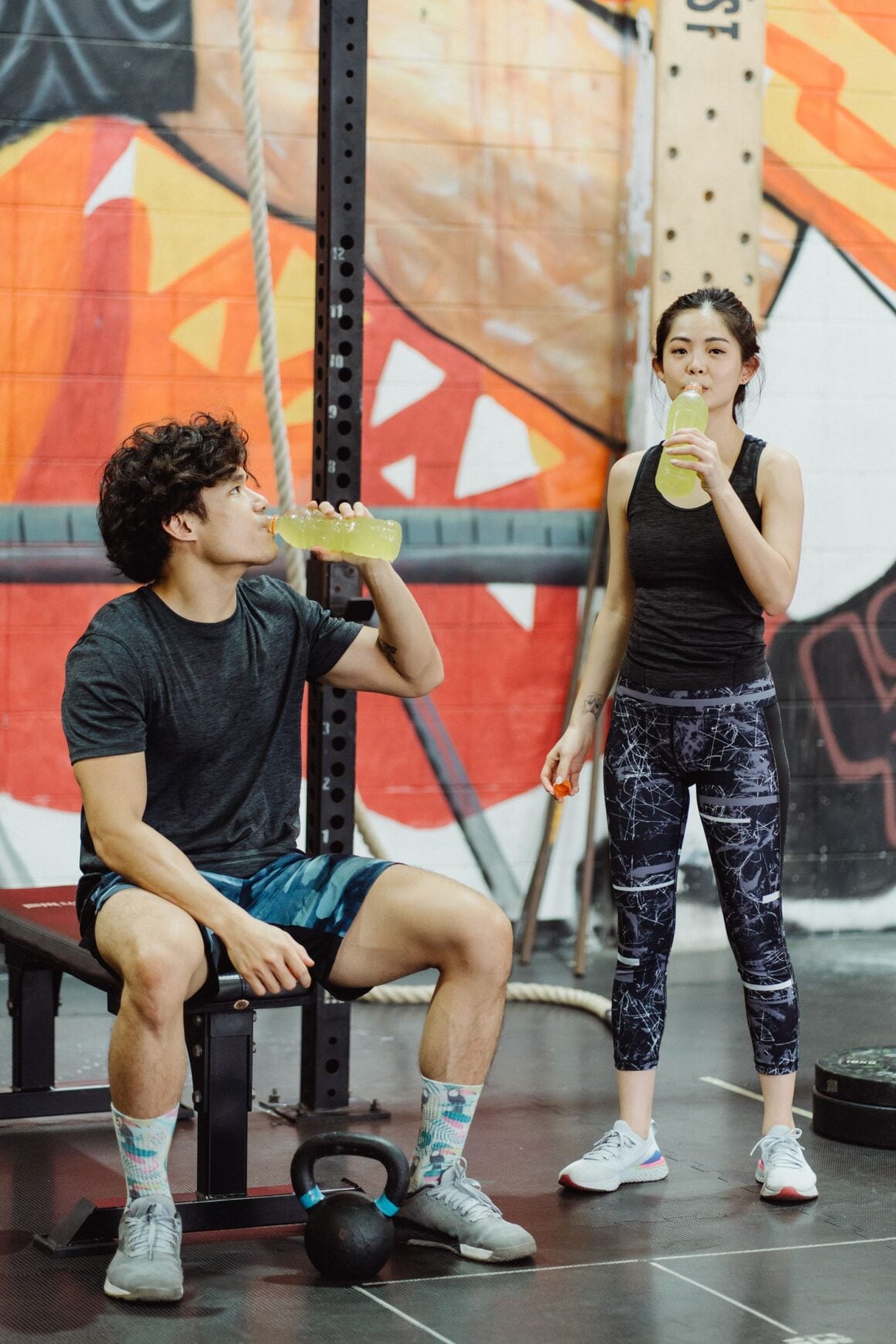

High-intensity training puts a bigger load on the cardiovascular system, the muscles, and the body’s heat-shedding machinery than steady-state work does. Kettlebell training in particular tends to be built out of short, dense bursts: a set of two-handed hip hinge swings, a complex, a minute of cleans and presses, then a rest window. Sweat piles up fast inside those bursts, and there is nowhere to drink during them.
That structure changes the hydration question. Drinking has to happen in the rest windows, because you can’t take a mouthful mid-set with a kettlebell in your hands. It also makes the total fluid cost of a session easy to underestimate, since the hard parts are short.
What Dehydration Actually Costs You
Water regulates body temperature, carries nutrients, supports muscle contraction and maintains blood volume. As intensity climbs, working muscles produce more heat, and sweating is the main route for getting rid of it.
The commonly cited threshold is 2% of body mass. The National Athletic Trainers’ Association position statement on fluid replacement reports that performance “was consistently reduced when hypohydration met or exceeded 2% body mass loss” in prolonged aerobic work, and similarly in anaerobic tasks.¹ For an 80 kg person that is a loss of 1.6 kg, or roughly 1.6 litres.
The same statement qualifies that figure, noting that “the 2% hypohydration threshold has little effect on overall exercise performance in recreational athletes.”¹ It works as a planning target, and being slightly under it on any given day is unlikely to ruin a 40-minute session in a temperate garage. The figure starts to carry real weight once sessions get long, hot, or closely spaced.
How Much a Hard Session Actually Costs
Barnes and colleagues compiled whole-body sweating rates across a large athlete sample and reported means by sport, ranging from 0.83 ± 0.34 L/h in baseball up to 1.51 ± 0.70 L/h in American football, with endurance athletes at 1.28 ± 0.57 L/h.²
A hard kettlebell session — complexes, snatches, high-rep swings, short rests — sits comfortably inside that band. Take 1.2 L/h as a working estimate for a demanding session in a normally ventilated space:
- A 30-minute session: roughly 600 ml. Easily replaced afterwards. Plain water, no strategy required.
- A 45-minute session: roughly 900 ml. Still well under the 2% mark for most adults.
- A 75-minute session in a hot garage: potentially 1.5 to 2 litres or more, which for a smaller person crosses 2%.
A typical 30 to 45 minute kettlebell session therefore needs very little planning around fluid. Long sessions, hot conditions, and two sessions in the same day are the cases where it starts to matter.
Start the Session Already Topped Up
The most common mistake is treating hydration as something that begins when the warm-up does. Starting a session already short makes it difficult to catch up once heavy sweating is underway.
Spread fluid across the day rather than loading up in the ten minutes before training. Urine colour is a reasonable rough cue: the NATA statement describes thirst, voiding frequency and urine colour as “valuable indicators over the course of a day or between days,” while warning that “spot urine samples at other times of the day can be confounded by fluid intake, exercise, and food intake.”¹ The first void of the morning is the more reliable check. Pale is fine, consistently dark suggests a shortfall, and a single dark sample an hour after a coffee means very little.
There is a specific reason not to drink heavily right before a kettlebell session. A stomach full of water and a hip hinge is an unpleasant combination. The difference between a hip hinge swing and a squat swing comes down to how much the torso folds over, and the hinge variant folds a lot. Add burpees, cleans, or anything with a rapid change of trunk position and the discomfort arrives quickly. Drink through the day, then sip rather than gulp in the last half hour. Cavemantraining also has a rundown on fuelling before a workout covering the food side of the same window.
Sodium, and Why the Dose Varies So Much
Sweat carries sodium, potassium, magnesium, chloride and calcium out along with the water. Sodium leaves in by far the largest quantity, which is why it dominates the conversation.
The size of that loss varies enormously between people. The NATA statement puts measured sodium losses at “between 0.2 and 7.3 g/h,” with sweat sodium concentrations spanning “10 to 100 mEq/L.”¹ That is a tenfold individual range in concentration alone. Two people can do the same session side by side and lose very different amounts of sodium.
The statement also sets a specific bar for when supplementation is indicated: individuals with sweat sodium concentrations “greater than 60 mEq/L” combined with sweat rates “greater than 2.5 L/h.”¹ Both conditions have to be met. That is a high bar, and it excludes most people doing a 40-minute kettlebell session indoors. A visible salt crust on a training shirt is the everyday sign of sitting toward the high end of the range.
If electrolytes do make sense for the kind of training being done, the dose is the thing to check, because product labelling in this category does not tell you much. A comparison of 57 electrolyte powders by Evident Reviews shows the sodium content per serving running from 50 mg at the bottom of the range to 1,695 mg at the top, with the bulk of products scattered in between. Check how much sodium is actually in a serving before buying, because the category name stays identical across a thirty-fold spread in dose. That comparison was built from labels, certificates of analysis, and published lab data rather than hands-on testing of every product, which the site states openly, so the per-serving figures are the useful part rather than the rankings.
Work Out Your Own Sweat Rate
All of the above are averages. Your own number takes about five minutes to establish. The NATA statement gives the calculation as:
Sweat loss (L) = Body mass before exercise (kg) − Body mass after exercise (kg) + (Volume of fluid consumed during exercise [L]) − (Urine volume, if any [L])¹
Weigh yourself in minimal dry clothing before and immediately after, account for anything you drank, and the difference is what left as sweat. Divide by session length for an hourly rate.
Do it twice: once for a moderate indoor session, once for something long and hot, such as a kettlebell EMOM workout run for 30 or 40 minutes in summer. The gap between the two numbers is the useful information, because it shows how much conditions rather than effort drive fluid loss.
What the Evidence Says About Cramping
Electrolyte products are routinely sold on cramp prevention, and the evidence behind that claim is weak.
Schwellnus reviewed the competing explanations for exercise-associated muscle cramps and found that support for the dehydration and electrolyte-depletion hypotheses “comes mainly from anecdotal clinical observations, case series totalling 18 cases, and one small (n = 10) case-control study,” and that “results from four prospective cohort studies do not support these hypotheses.”³ The better-supported mechanism is altered neuromuscular control — fatigue-driven changes in the reflex loops governing muscle contraction.
Forearm and hand cramping during high-rep swings or snatches is the version of this most kettlebell trainees will run into, and it is a local fatigue problem in the muscles doing the gripping. Sodium intake has no bearing on a grip that has run out of capacity. Shortening the set, correcting the grip, or letting the kettlebell hang in the fingers instead of crushing the handle will all help more.
Too Much Water Is Its Own Problem
Drinking very large volumes of plain water over a short period can dilute blood sodium, which in serious cases leads to exercise-associated hyponatremia.
This is often dismissed as a marathon problem. The 2017 update by Hew-Butler and colleagues documents cases well outside ultra-endurance, including rugby players after an 80-minute match, yoga classes, low-intensity lawn bowling, and “2 h of weightlifting plus tennis.”⁴ The primary mechanism is drinking beyond thirst, compounded by non-osmotic vasopressin release during exercise.
The same review offers a straightforward safeguard: drinking to thirst “will prevent the development of EAH when exercise is performed in temperate climates with duration of less than 17 h.”⁴ No kettlebell session comes close to that duration. The risk comes from force-drinking to hit a target volume.
Headaches get blamed on dehydration in the same reflexive way. Exertion headache and migraine both present differently and have different fixes, and there is a full breakdown of headaches after kettlebell training that separates the three before you reach for a water bottle.
Sweat Changes the Grip
Sweat changes the contact between hand and handle, which barely applies to barbell or machine work but applies constantly to kettlebells.
A wet handle on a coated kettlebell turns slippery, and that shows up most in the situations where sweat is heaviest — high-rep sets, hot rooms, and long conditioning pieces. Overgripping to compensate is how blisters and tears start. Chalk, a towel within reach, and a handle kept free of rust and irregularities all belong in the same conversation as fluid intake. Cavemantraining’s guide to kettlebell hand maintenance covers the chalk options and handle upkeep in detail, including why block chalk works better on the kettlebell itself than liquid chalk does.
After the Session
Drink gradually after training rather than in one go, and let food do part of the work. Fruit, vegetables, yoghurt and soups supply water alongside sodium and potassium, and an ordinary post-training meal restores electrolyte balance for most people without anything being added to it. Anyone paying attention to protein intake for kettlebell training is probably already eating in a way that covers it.
Stacked sessions change this. Training again the same day, or early the next morning, shortens the window for replacing what was lost, and that is the one case where drinking on a plan rather than on thirst makes sense.
Putting It Together
For the large majority of kettlebell sessions — 30 to 45 minutes, indoors, moderate temperature — plain water and ordinary meals are sufficient. Arrive topped up, keep water within reach for the rest windows, and drink normally afterwards.
Long sessions, hot conditions, and closely stacked training days are where it pays to be deliberate. Measure your own sweat rate instead of guessing at it. If you do buy an electrolyte product, check the sodium per serving, because the category name will not tell you. And treat thirst as a usable guide rather than something to be overridden with a target volume.
References
- McDermott BP, Anderson SA, Armstrong LE, Casa DJ, Cheuvront SN, Cooper L, et al. National Athletic Trainers’ Association Position Statement: Fluid Replacement for the Physically Active. J Athl Train. 2017;52(9):877–895. https://doi.org/10.4085/1062-6050-52.9.02
- Barnes KA, Anderson ML, Stofan JR, Dalrymple KJ, Reimel AJ, Roberts TJ, et al. Normative data for sweating rate, sweat sodium concentration, and sweat sodium loss in athletes: An update and analysis by sport. J Sports Sci. 2019;37(20):2356–2366. https://doi.org/10.1080/02640414.2019.1633159
- Schwellnus MP. Cause of exercise associated muscle cramps (EAMC) — altered neuromuscular control, dehydration or electrolyte depletion? Br J Sports Med. 2009;43(6):401–408. https://doi.org/10.1136/bjsm.2008.050401
- Hew-Butler T, Loi V, Pani A, Rosner MH. Exercise-associated hyponatremia: 2017 update. Front Med. 2017;4:21. https://doi.org/10.3389/fmed.2017.00021
- Workouts
- Courses
- Certifications
- Coaches
- Live feed

