
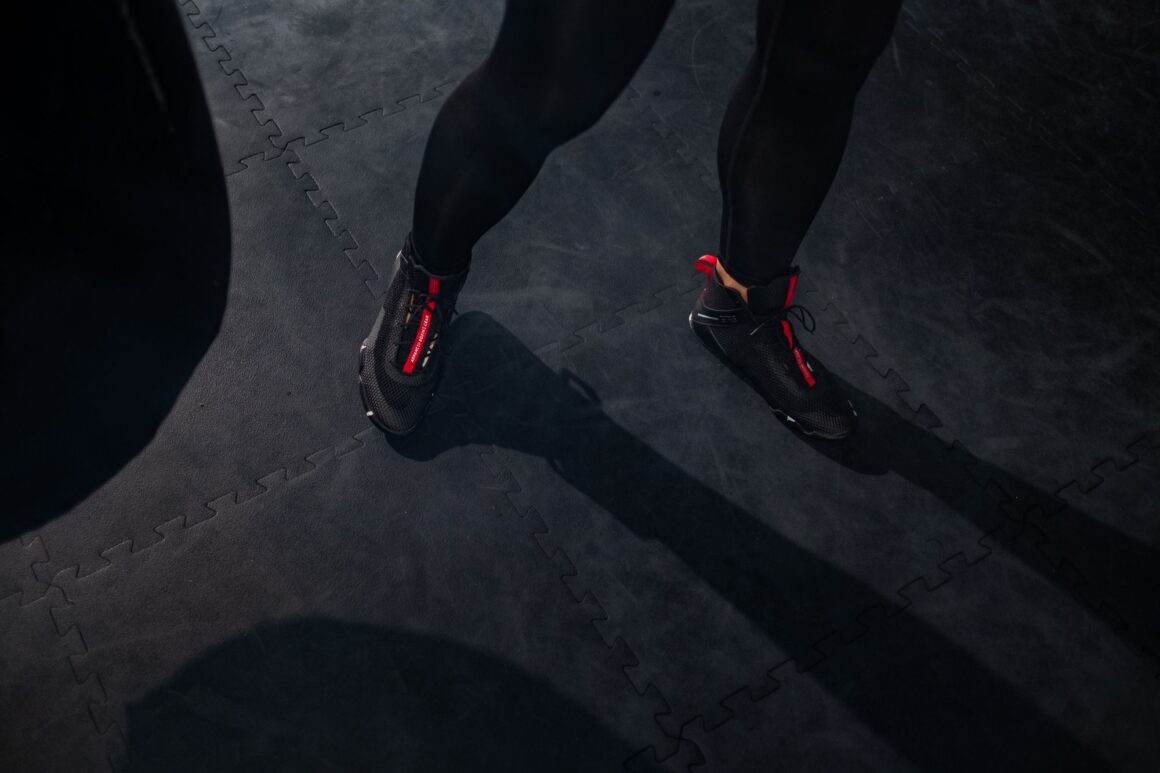
Most articles about training shoes for weightlifting start by assuming you need a shoe. We are going to start one step earlier than that, because the answer we give our own students is that for kettlebell training you are usually better off without one.
That position is not shared by everyone, and it is not always practical. Plenty of gyms will not let you through the door barefoot. Plenty of people have feet that are not ready for it yet. So this covers what we actually recommend, in order, and what to look for in a shoe when the first option is off the table. Sole, heel-to-toe drop, width, grip, and how those change depending on whether you are squatting, deadlifting, or working through a kettlebell session.
Our Order of Preference
Four options, best first. The further down the list you go, the more you are accepting a compromise, and it helps to know which compromise you are accepting.
- No shoes. This is the recommendation. Your feet get stronger, your toes can spread and grip the floor, and nothing sits between you and the surface you are producing force against. There is research behind it as well: six months of daily activity in minimal footwear increased maximum toe flexion strength by an average of 57%.¹ Our full reasoning is in what shoes to wear for kettlebell training, and the obvious objection is answered separately in training in bare feet, what if you drop the kettlebell.
- A minimal shoe. Flat, zero drop, thin sole, flexible enough to bend where your foot bends, and a toe box wide enough for your toes to separate. Xero, Vibram and Vivobarefoot all make shoes that meet that description. This is what to wear in a gym that requires footwear.
- A flat conventional shoe. Canvas flats, deadlift slippers, wrestling or boxing boots. Thin, firm, no heel lift, and cheap. What they get wrong is width, because most of them still taper at the front and squash your toes together. If your feet are a normal width and you need something today from a normal shop, this works.
- Genuine width. For feet that do not fit conventional footwear at all. Covered at the end of this article, because it comes with conditions.
Options three and four fail in opposite directions. A flat conventional shoe gets the sole right and the shape wrong. A therapeutic wide shoe gets the shape right and the sole wrong. Which of those you can live with depends on your own feet.
One caution before you change anything. If you have spent your whole life in cushioned shoes with a raised heel, your calves, Achilles and feet have adapted to that. Going straight to barefoot training or a zero-drop shoe for a full session is how people end up with sore feet and blame the concept. Build up gradually. We covered the transition in barefoot is for hippies, or is it.
Why the Sole Matters
Your feet are your connection to the floor. When you are producing force against the ground to move a heavy kettlebell or a barbell, you want that connection to be predictable.
Running shoes are built to do the opposite. A cushioned midsole is designed to compress and absorb impact, which is useful when you are landing on it repeatedly and unhelpful when you are trying to push against it. Under load, a squishy sole compresses unevenly and your foot has to keep correcting for it.
Working in an unstable environment does improve stability, and there is a place for that. Doing it under load in every session with no progression is not that place, in the same way that doing 200 clean and jerks unbroken in every workout is not a training plan.
So the sole wants to be firm and, for our purposes, thin. A dedicated squat shoe gives you firm and thick. A minimal shoe or a bare foot gives you firm and thin, which keeps the ground feedback that a thick sole removes.
Heel-to-Toe Drop
Heel-to-toe drop is the height difference between the heel and the forefoot. Most conventional trainers sit somewhere between 8 and 12 mm. Dedicated squat shoes go considerably higher, often 15 to 20 mm or more.
The mechanical effect is straightforward. Raising the heel reduces how much ankle dorsiflexion you need to reach depth, so the knees travel forward more easily and the torso stays more upright. That is why people who squat in them like them.
It does not give you the ankle range you were missing. It works around the shortage, which means the depth you can reach in the shoe is not depth you own without it. Our own take on depth and what limits it is in the definite answer to how deep should you squat.
For deadlifting, most people prefer the opposite. A thin, flat sole keeps the foot close to the floor, which shortens the distance the weight has to travel, and there is no heel lift shifting your weight forward at the start.
For kettlebell training, zero drop is what we recommend, for squatting and hinging alike. If your ankles are the limiting factor, work on the ankles.
Fit, Toe Box, and Width
This is where most training shoes fail, and it matters more than the marketing on the box.
You want two things at once. The heel and midfoot need to be held in place so your foot is not sliding around inside the shoe under load. The forefoot needs room for your toes to spread, because spread toes are a wider, more stable base than squashed ones. Most shoes deliver the first and not the second.
Shoe length on its own does not tell you whether a shoe fits. Two other things decide that:
Arch length, meaning where the shoe bends compared to where your foot bends. A shoe that is the right overall length can still crease in the wrong place.
Actual width, which is not the same as a roomy toe box. A shoe can be described as wide and still be a standard last with a bit more space at the front. Genuine width is a different pattern, not a bigger version of the same one.
If you have never worn anything but conventional shoes, a wide toe box feels strange at first. That passes.
Grip
The outsole needs to hold position on the surface you train on. Sliding during a loaded exercise is a safety issue, and it matters for squats, deadlifts, swings, and anything else where you are driving through the floor.
More grip is not automatically better. An aggressive tread can catch when you need to pivot, which comes up in kettlebell work more than in barbell work. What you want is grip that behaves the same way every rep, not the most aggressive tread available.
Matching the Shoe to the Session
Squats
A firm platform, a secure heel and midfoot, and room at the front. Whether you want heel elevation depends on your ankle range and your stance, and our position is to fix the ankle rather than build the position on top of a wedge.
Deadlifts
Flat and thin. Close to the floor, no heel lift, reliable grip, and enough width that your foot is not being compressed at the point where you are trying to push the floor away.
Kettlebell Workouts
A kettlebell session moves through more positions than a barbell session does. Swings, cleans, presses, goblet squats, get-ups, carries, and transitions between all of them. You need the floor feedback, you need your toes to spread for balance, and you need the shoe to bend when your foot bends. That is the argument for barefoot, and failing that for the thinnest, flattest, widest shoe you will actually wear.
Can One Pair Cover All Three?
Yes, and this is the part where our answer is simpler than most.
If you are training barefoot, the question does not arise. If you need a shoe, one flat, thin, wide, zero-drop pair covers squats, deadlifts and kettlebell work without compromise, because all three want the same things from a shoe.
The only people who genuinely need specialist footwear are competitive Olympic weightlifters and powerlifters, who are optimising for a specific position under a specific bar on a specific day, and who have usually earned the right to that trade-off. For everyone else, buying a raised-heel squat shoe and a flat deadlift shoe is solving a problem you do not have.
That said, GS athletes compete in shoes because the rules require it, and if you compete in shoes you will probably train in them. We wrote about that tension in what are the best shoes for kettlebell training.
Quick Checklist
Before you buy anything:
- Could I train barefoot instead? Have I actually tried?
- Is the sole firm rather than squishy?
- Is it thin enough that I can feel the floor?
- Is the drop zero, or as close to it as I can find?
- Does it bend where my foot bends?
- Can my toes spread inside it, not just fit inside it?
- Does the heel stay put when I move?
- Does the outsole hold without catching when I pivot?
- Am I buying for how I train, or for how the shoe looks?
When Your Feet Do Not Fit Normal Shoes
Everything above assumes a shoe exists in your size and shape. For some men it does not.
Very broad forefeet, bunions, hammertoes, swelling, or a need to fit custom orthotics or braces will all put you outside what standard sizing covers, and standard “wide” will not solve it. For reference, 6E is roughly three quarters of an inch to an inch wider than a standard D width. Retailers such as DT Footwear carry 6E shoes for men and go wider still.
Be clear about what those shoes are. They are therapeutic and comfort footwear, built for foot conditions and all-day wear rather than for training. Arch support, contoured orthotic insoles and gel-padded heel seats are exactly the features we have spent this article arguing against, and some models are explicitly not intended for high-impact activity.
Two things make them worth mentioning anyway. Width is the one thing on our list you cannot work around, and this is one of the few places that genuinely delivers it. And because these shoes are built with extra depth so that people can fit their own orthotics, the insoles come out. Pull the insole and you get a flatter, roomier shoe than the one that arrived in the box.
If you go this route, check what is left after you remove the insole. Is the sole firm rather than squishy? What is the drop? Does it bend? A shoe that fits your foot and fails those checks is still better than a shoe that fails to fit your foot at all, but know which compromise you have made, and keep working towards the ones higher up the list.
Reference
Curtis R, Willems C, Paoletti P, D’Août K. Daily activity in minimal footwear increases foot strength. Sci Rep. 2021;11:18648. https://doi.org/10.1038/s41598-021-98070-0

