
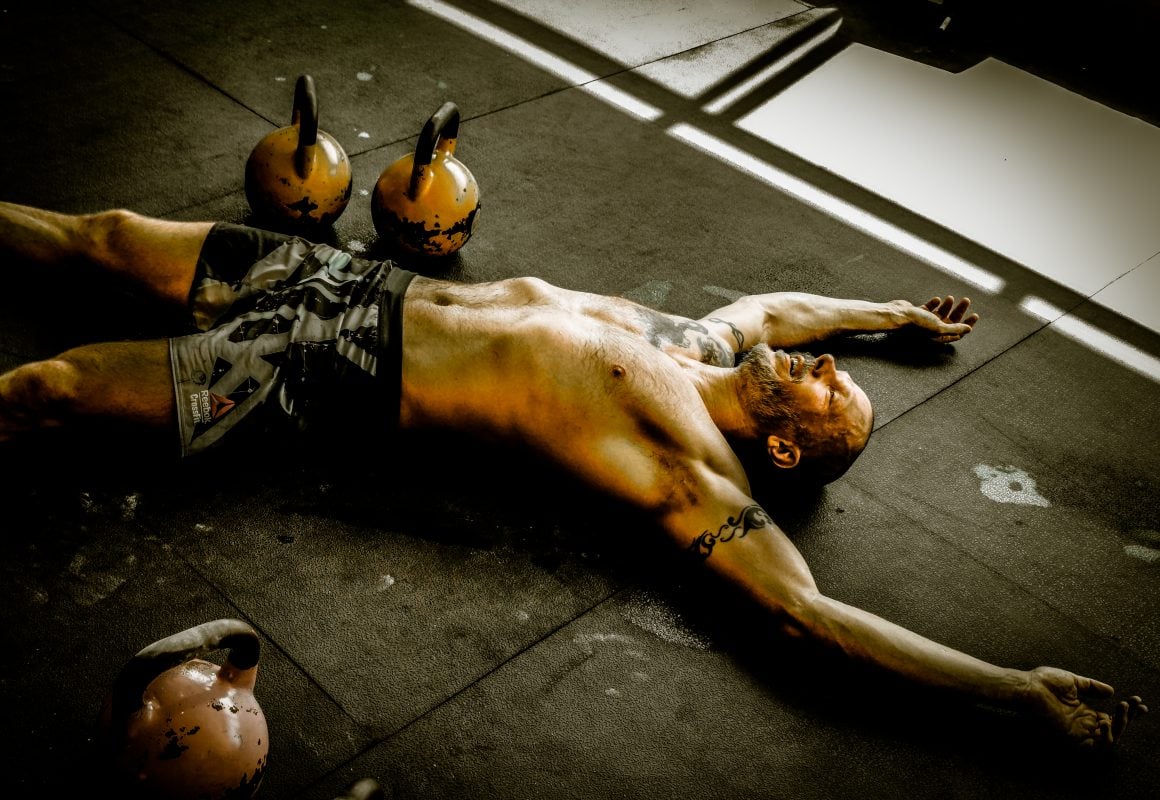
You finish a set of hip hinge swings, put the kettlebell down, and twenty minutes later your head is pounding. The standard advice is to drink more water. That works when fluid loss is what happened, and it sends you in the wrong direction the rest of the time.
Almost everything written on this subject compares two options, a dehydration headache and a migraine. That comparison leaves out a third type that sits squarely in the middle of what kettlebell training does to the body. Primary exercise headache is brought on by strenuous effort, and in the only cohort study that followed resistance-trained athletes month by month, around three quarters of the episodes happened during upper-body work rather than lower-body work. Overhead exercises, breath-holding under load, and neck position during a hinge are all in that territory.
This article covers all three, what separates them, what a hard kettlebell session actually costs in fluid and sodium, and the symptoms that mean you stop and get assessed instead of reaching for a water bottle.
What a Dehydration Headache Is, and How Firm the Category Actually Is
A dehydration headache is head pain that appears when body fluid drops far enough to matter. The proposed mechanism is that fluid loss produces temporary changes in the brain and surrounding tissues, placing traction on pain-sensitive structures around the brain.
The clinical description comes largely from work by Blau and colleagues, who asked family, colleagues, and acquaintances whether losing fluid gave them a headache. Roughly one in ten of the people asked said yes. In most of them the pain was aching rather than sharp, and it got worse with head movement, bending down, or walking. Drinking fluid resolved it, in most cases within thirty minutes, in the rest within one to three hours.
Worth knowing, because it shapes how much weight to put on the label: the International Classification of Headache Disorders (ICHD-3) has no standalone entry for dehydration headache. It falls under headache attributed to another disorder of homoeostasis. The experience is well described in the literature and familiar to most people who train in heat. The category itself is looser than the confident comparison tables online suggest.
Fluid loss usually comes with other signs. Thirst, dry mouth, fatigue, dizziness. Urine darker than your own normal can indicate you need more fluid, though diet, supplements, and medication also change its colour, so treat it as one input rather than a test.
One trap: if the headache eases after you drink and rest, that does not confirm what it was. Time passed too, and most exercise-triggered headaches settle on their own within an hour.
Primary Exercise Headache: The One Missing From Most Comparisons
ICHD-3 classifies this one directly. Primary exercise headache is defined as head pain brought on by, and occurring only during or after, strenuous physical exercise, lasting under 48 hours, with no intracranial disorder behind it. The classification notes it happens particularly in hot weather or at altitude, and that “weight-lifters headache” is a recognised presentation without being separately classified.
A cohort study followed 116 resistance-trained men over five months and recorded 38 episodes across 23 of them. Prevalence during follow-up was 19.8%, and incidence worked out at 4.8 episodes per 1000 hours of training. The pattern that came out of it is useful:
- Most episodes started after the session rather than during it, with reported onset intervals falling within an hour of starting to train
- Onset was sudden in 81% of cases
- Pain was bilateral in 66% and pulsating in 47%
- The most common site was occipital, at the back of the head, in 39%
- 92% lasted between five and sixty minutes
- 76% occurred with upper-limb resistance work, 24% with lower-limb work
- Athletes linked 76% of episodes to neck movement and 74% to the heaviness of the weight
- Average pain intensity was 3 out of 10
That is a small, male-only, questionnaire-based sample with no imaging, so read the numbers as a pattern rather than a population estimate. The prevalence was higher than most general-population figures, which range from well under 1% up to about 12% depending on the study and the definition.
The proposed mechanism is vascular and pressure-related. Sustained straining raises pressure in the intracranial venous sinuses, which raises intracranial pressure and reduces cerebral blood flow. Breath-holding against a closed airway during effort is the obvious contributor.
Three parts of kettlebell training put you in that description.
Overhead and upper-body work. Snatch, press, jerk, and the overhead holds inside a Turkish get-up are all upper-limb resistance work performed with the head and neck under load. That was the category producing three quarters of the episodes in the cohort above.
Breath-holding. Bracing hard and holding the breath through repetitions is a habit that develops without anyone deciding on it, particularly when the weight starts feeling heavy. Our swing instruction has always been to breathe with the exercise rather than through it: inhale through the nose, exhale through the mouth, and do not hold the breath. See the kettlebell swing technique breakdown for where the breath goes in the hip hinge version.
Neck position. The occipital location and the association with neck movement are hard to ignore given how much argument there is about where the head should point during a hinge. We cover the two positions and the reasoning behind each in kettlebell swing neck position, neutral spine or eyes on the horizon. Someone getting repeated headaches at the back of the head after swing volume should look at that before assuming a fluid problem.
There is a hard rule attached to this diagnosis. The first time you get a headache with these characteristics, subarachnoid haemorrhage, arterial dissection, and reversible cerebral vasoconstriction syndrome have to be excluded. That requirement sits in the classification itself rather than in a cautionary footnote somewhere. If this is the first time exertion has produced a headache like this for you, get it looked at before you spend time working out which category it belongs to.
Migraine, and Why Two-Sided Pain Does Not Rule It Out
A migraine is a separate neurological disorder with a strong genetic component, involving changes in neurological signalling that produce head pain alongside sensory, gastrointestinal, and other symptoms. Severity alone does not make a headache a migraine, and a severe dehydration headache is still a dehydration headache.
The ICHD-3 criteria ask for attacks lasting 4 to 72 hours untreated, with at least two of four features: one-sided location, pulsating quality, moderate or severe intensity, or aggravation by routine physical activity. Plus at least one of nausea or vomiting, or the combination of light and sound sensitivity.
Two of those deserve attention if you train.
First, one-sided pain is one of four optional features, not a requirement. A record review of 477 migraine patients at a headache clinic found fewer than half reported lateralised pain. Pain on both sides does not rule migraine out.
Second, the criterion about routine physical activity making it worse is the one that matters most in a gym. A migraine typically gets worse if you keep moving. Primary exercise headache in the cohort above resolved within an hour in more than nine out of ten episodes, and 40% of the athletes carried on training through it.
Migraine aura, when it occurs, involves fully reversible visual, sensory, speech, or other neurological symptoms that usually build gradually and can arrive before or during the headache phase. Aura was not reported at all in the exercise-headache cohort.
Dehydration can act as a trigger in people who are susceptible to migraine, which is where the two categories genuinely overlap. It sits alongside disrupted sleep, missed meals, stress, and hormonal changes as one contributor among several rather than the explanation.
Comparing the Three
| Feature | Dehydration headache | Primary exercise headache | Migraine attack |
|---|---|---|---|
| Trigger | Fluid loss from heat, sweating, illness, or low daily intake | Strenuous effort, more likely in heat or at altitude | Various, including stress, sleep disruption, missed meals, hormonal changes, and sometimes dehydration or exertion |
| Timing relative to training | Any time fluid deficit builds, not tied to the session | During or shortly after, commonly within an hour of starting | Any time, may build over hours |
| Pain quality | Usually aching, worse with head movement or bending | Sudden onset in most cases, often pulsating | Pulsating, moderate to severe |
| Location | Variable, often diffuse | Frequently both sides, often at the back of the head | Both sides in a large minority, often frontotemporal |
| Duration | Until fluid is replaced, typically under three hours | Under 48 hours by definition, and most episodes five to sixty minutes | 4 to 72 hours untreated |
| Effect of continued activity | Not a defining feature | Often continues but tolerable, average intensity 3 out of 10 | Typically worsens, often forces you to stop |
| Nausea, light and sound sensitivity | Not defining features | Not defining features | Common and often severe |
| Aura | No | Not reported in the resistance-training cohort | In a subset, fully reversible |
| Response to drinking | Usually resolves once fluid is replaced | May resolve on its own regardless | Fluid may help if dehydration was a trigger, but the attack can run its course anyway |
| First occurrence | Manage and monitor | Requires medical assessment to exclude serious causes | Requires diagnosis if recurring |
Symptoms overlap, and you can have more than one thing happening. Someone can be genuinely short of fluid and having a genuine migraine at the same time.
What a Kettlebell Session Actually Costs You
Generic hydration advice fails here because the numbers vary so widely between people.
Kettlebell work is metabolically expensive even at modest loads. In one of the earliest studies to measure it, ten men performed as many two-hand hip hinge swings as they could in twelve minutes with a 16 kg kettlebell. They averaged 265 repetitions and held an average heart rate of 86.8% of maximum, with oxygen uptake at 65.3% of maximum. That is the cardiovascular cost of hard continuous exercise, produced by twelve minutes and one relatively light kettlebell.
The individual variation is the part that undoes any single recommendation. Measured sweat rates during exercise span roughly 0.5 to 2.0 litres per hour, and sweat sodium concentration spans roughly 10 to 90 mmol per litre. The person next to you in the same room doing the same workout can lose four times the fluid and nine times the sodium per litre that you do. Exercise intensity, heat, humidity, heat acclimatisation, aerobic fitness, body size, sex, diet, genetics, and how hydrated you started all move those numbers.
Which is why a blanket figure for daily water intake tells you very little about your own session. If you want an actual answer, weigh yourself before and after a training session with minimal clothing, dry off, and account for anything you drank during it. Each kilogram lost is roughly a litre of fluid. Do that across a hot session and a cool one and you will know more about your own requirement than any general guideline can tell you. Starting the session already topped up matters as well, which is covered in more detail in our notes on fuelling and hydration before a workout.
When Drinking More Water Makes Things Worse
This is the part that generic hydration content tends to leave out, and it changes the advice.
Exercise-associated hyponatremia is a fall in blood sodium during or within 24 hours after physical activity. The 2015 international consensus statement identified the main driver in most cases as drinking more hypotonic fluid than the kidneys can excrete, combined with sustained non-osmotic vasopressin secretion, rather than sodium loss through sweat being the primary problem. Headache is one of its symptoms, and so is nausea. Both of those also appear on every dehydration checklist you will read, which is where it gets dangerous, because the standard response to a post-training headache is to drink more, and in someone already fluid-overloaded that makes the condition worse.
The consensus recommendation is to drink to thirst rather than to a schedule or a target volume. That panel reconvened in response to two preventable deaths in high school football players from dilutional hyponatremia, so this is not a theoretical concern for hard-training people in heat.
There are two practical consequences for training. Do not respond to a headache by drinking large volumes fast. And if a headache after training comes with nausea, confusion, or swelling, and you have been drinking heavily, that needs assessment rather than more fluid.
Symptoms That Mean Stop and Get Assessed
Some head pain needs medical assessment rather than a self-management plan. Seek urgent care for:
- A sudden, extremely severe headache that reaches peak intensity within seconds
- Your first ever headache triggered by exertion, which requires exclusion of bleeding, arterial dissection, and vasospasm
- Confusion, weakness, numbness, difficulty speaking, or significant vision changes
- Fever with neck stiffness
- Headache following any impact to the head
- Pain that keeps worsening rather than settling
- Symptoms that do not improve with rest and sensible fluid intake
Recurring headaches that interfere with your day, or a change in your usual pattern, warrant a booked appointment rather than emergency care. A shifting pattern is worth having someone qualified look at.
What We Ask People to Check First
When a student reports headaches around training, the first thing we look at is the session itself rather than what they drank.
Note down what the session contained on the days it happens and the days it does not. Overhead volume specifically, since that is the category most associated with exercise headache. Room temperature and airflow. Whether you were holding your breath, which almost nobody notices about themselves. Where your head was pointing during hinge repetitions, and whether you were craning to watch the kettlebell. How long after finishing the pain arrived, and how long it lasted. Whether nausea or light sensitivity came with it.
Three or four sessions of that will usually separate the fluid explanation from the exertion explanation, because the fluid one tracks with heat and intake while the exertion one tracks with what you were doing and how you were breathing.
If breathing or neck position turns out to be involved, get eyes on it. Post a video of the exercise through CONNECT free coaching and a certified IKU™ coach will review it with freeze-frame notes pinned to the point where technique breaks down. Recovery habits matter around all of this too, and our piece on building recovery for athletes covers the surrounding pieces.
Common Questions
Is a headache after kettlebell training dangerous?
Most are not. Primary exercise headache is classed as a primary headache, meaning no underlying disorder is causing it, and the majority of episodes in the research resolved within an hour. The first time it happens is the exception, because serious causes present the same way and have to be ruled out.
Should I stop training if I get one?
In the cohort study, 60% of athletes stopped and 40% continued. If it is mild, familiar, and settles quickly, stopping is a judgement call. If it is new, severe, sudden, or comes with any neurological symptom, stop and get assessed.
Why does it happen more with pressing and snatching than with swings?
Upper-limb resistance work accounted for around three quarters of episodes in the research, and athletes linked most episodes to neck movement and to the heaviness of the weight. Overhead exercises combine both, along with more breath-holding.
Will drinking more water prevent it?
It prevents the dehydration variety, and staying reasonably hydrated is worth doing regardless. It does not prevent primary exercise headache, which is driven by pressure and effort rather than fluid balance. Drinking large amounts to prevent a headache carries its own risk.
Does training in a hot garage make it more likely?
Yes, for both. Heat raises sweat losses and the classification explicitly notes that primary exercise headache is more common in hot weather.
Can I have more than one of these at once?
Yes. In the same cohort, tension-type headache and probable migraine coexisted with exercise headache in a minority of athletes. Being short of fluid does not protect you from a migraine.
Where Electrolytes Actually Fit
Sodium is the electrolyte lost in the largest quantity through sweat, and it has a major role in regulating fluid balance outside the cells. In glucose-containing oral rehydration solutions, sodium and glucose work together to support water absorption in the small intestine. During heavy sweating, prolonged heat exposure, long sessions, or illness with vomiting or diarrhoea, replacing sodium alongside water is reasonable, and it matters more if you sit at the high end of that 10 to 90 mmol per litre range.
Choosing between products is where the marketing usually takes over. Two criteria come straight out of the numbers above and are worth applying to anything you pick up.
The first is whether you can control the sodium dose by itself. Your sweat sodium concentration is individual, so a fixed sachet built around a set sodium-to-sugar ratio hands you the same dose whether you needed a third of it or three times it. Something you add by volume lets you match the dose to what you measured on the scales.
The second is whether the label lets you do the arithmetic. Sodium has a molar mass of about 23, so 300 mg of sodium works out at roughly 13 mmol. Lose a litre of sweat at a mid-range 50 mmol per litre and you have lost around 1,150 mg of sodium. A single 300 mg serving covers about a quarter of that litre. A product that will not let you run that calculation is asking for trust you have no way of checking.
Buoy’s page on electrolytes for headaches works as an example of both checks. Their Rescue Drops are an unflavoured liquid concentrate at 300 mg sodium per serving with no sugar or sweeteners, so sodium is the only variable being added and the dose scales with how much you use. The page is also straight about the limits, stating that electrolytes are not a guaranteed prevention method and that persistent or severe symptoms belong with a healthcare provider. We are pointing at it as an illustration of what to read on a label, not as a recommendation to buy anything, and the same two checks apply to every brand on the shelf.
None of this applies to migraine, which is not a sodium problem, and none of it applies to a headache driven by intracranial pressure during effort. If yours turns out to be the exertion type, the things worth adjusting are your breathing, your neck position, and how much overhead work sits in the session.
References
- 4.2 Primary exercise headache. ICHD-3, International Headache Society
- 1.1 Migraine without aura. ICHD-3, International Headache Society
- 10.7 Headache attributed to other disorder of homoeostasis. ICHD-3
- Noormohammadpour P, et al. Incidence of Primary Exercise Headache in Resistance Trained Athletes. Asian J Sports Med. 2017;8(4):e59489. https://doi.org/10.5812/asjsm.59489
- Blau JN, Kell CA, Sperling JM. Water-deprivation headache: a new headache with two variants. Headache. 2004;44(1):79–83. https://doi.org/10.1111/j.1526-4610.2004.04014.x
- Arca KN, Halker Singh RB. Dehydration and Headache. Curr Pain Headache Rep. 2021;25(8):56. https://doi.org/10.1007/s11916-021-00966-z
- Farrar RE, Mayhew JL, Koch AJ. Oxygen cost of kettlebell swings. J Strength Cond Res. 2010;24(4):1034–6. https://doi.org/10.1519/JSC.0b013e3181d15516
- Baker LB. Sweating Rate and Sweat Sodium Concentration in Athletes: A Review of Methodology and Intra/Interindividual Variability. Sports Med. 2017;47(Suppl 1):111–128. https://doi.org/10.1007/s40279-017-0691-5
- Hew-Butler T, et al. Statement of the Third International Exercise-Associated Hyponatremia Consensus Development Conference, Carlsbad, California, 2015. Clin J Sport Med. 2015;25(4):303–320. https://doi.org/10.1097/JSM.0000000000000221
- Loder E, et al. Migraine Pain Location and Measures of Healthcare Use and Distress: An Observational Study. Pain Res Manag. 2018;2018:6157982. https://doi.org/10.1155/2018/6157982

