
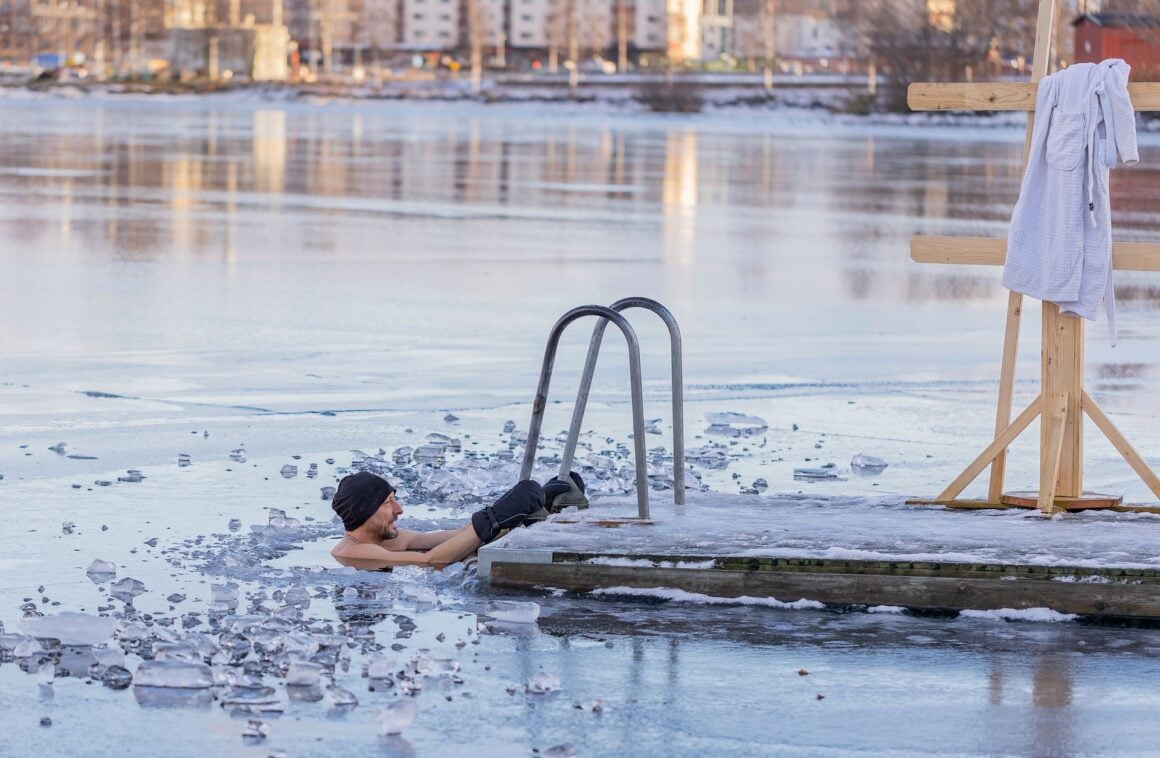

Cold plunge tubs are easy to set up at home now, and some people who train with kettlebells have one in the backyard. Fewer pair it with heat, and the order of the two gets little attention. If you train three or four days a week, the order and the days you choose can decide whether a recovery session helps your next workout or gets in the way.
Heat first and cold last is a common contrast format, with every block on a timer. On days you’re trying to get stronger, treat hard cold as a trade-off rather than an automatic recovery tool.
1. Why heat goes first and cold goes last
A dry sauna runs at about 80–100°C. Ten to fifteen minutes in one lifts your core temperature and gets you sweating, and many people come out feeling looser, particularly through the hips and upper back.
Many people also find cold water easier to face when they’re already hot. Walking into a 12°C plunge straight from the change room is a hard start. Finishing on cold then brings your temperature back down, so you leave alert instead of dripping sweat in the car park.
Steam rooms are cooler, usually 40–50°C. Humidity sits near 100%, so sweat can’t evaporate and they feel every bit as hot. Either one covers the heat half.
There’s a catch specific to kettlebells. Heat and moisture soften the skin on your palms, and soft calluses tear, which is the last thing you want going into a session of high-rep snatches. Save the sauna for after a snatch day rather than before one. That is also a good time to file your calluses down while the skin is still soft, using the scraper approach covered in kettlebell hand maintenance.
The evidence for contrast therapy is modest. A 2013 PLoS One meta-analysis led by François Bieuzen pooled 18 trials and found that alternating hot and cold water reduced muscle soreness and limited the loss of strength after hard exercise better than passive rest did.¹ It did no better than plain cold water, warm water, compression, stretching or an active cool-down, and the authors rated every one of the trials at high risk of bias.
Those trials also used water on both sides: mostly a minute in 8–15°C water, alternating with one to three minutes in water of about 35–45°C. Nobody in them sat in a sauna. The routine below borrows the idea of alternating heat and cold, but the exact sauna-and-plunge format has not been tested in the same way. What contrast therapy may help with is muscle soreness and how recovered you feel for the next session. It is not a proven way to improve long-term strength.
A newer review of cold-water immersion pooled 52 studies. After high-intensity exercise, cold water improved muscle soreness, perceived recovery and power at 24 hours, but did not improve recovery of strength.⁵
2. Timed blocks that fit a kettlebell week
This is a practical starting template, not a tested optimal protocol. Use a timer rather than deciding the length of each block by feel.
Set your phone for 10–15 minutes of sauna or steam. Follow it with 2–5 minutes in the plunge at roughly 10–15°C. If cold water is new to you, start at two minutes and the warmer end of that range. Sit at room temperature for a few minutes before the next round, and make sure the last thing you do is cold.
Two rounds suits most people. You can do three, though the extra round mostly adds time.
Give yourself a gap after training. Coming off a ten-minute long cycle set, your heart rate and core temperature are already high, and stepping into 90°C heat puts a second load on top of the first. Wait until your heart rate has settled and you’ve had a drink.
Fluid loss catches people out. A long cycle set already costs plenty of sweat, and each sauna round adds to it. For your first few sessions, weigh yourself before and after. The difference is roughly the fluid you’ve lost, and the article on staying hydrated during high-intensity workouts explains what to do with that number.
3. Check this before your first session
Sudden immersion in cold water drives your heart rate and breathing up sharply. A 2017 review of cold water immersion looks at it as a hazard as well as a treatment, including its role in cardiac arrest.² Heat adds its own load on the heart.
If you have a heart or blood-pressure condition, or any other medical condition, check with your doctor before starting. Get into the plunge slowly, keep your face out of the water and do not hold your breath. Do not do it alone, and get out if you feel dizzy, faint or short of breath.
4. Keep hard cold off your strength days
In 2015, Llion Roberts and colleagues published a trial in the Journal of Physiology that matters for anyone who owns an ice bath.³ Twenty-one young men with at least a year of resistance training behind them trained their legs twice a week for 12 weeks. After each session, one group sat in 10°C water for ten minutes while the other cycled easily for ten minutes. Quadriceps muscle mass rose by about 15% in the cycling group and about 2% in the cold group. Strength gains were smaller with cold too: about 42% on the leg press against about 59%.³˒⁴
The researchers also found that cold blunted the cell signalling in muscle that drives those gains.³ A 2021 review of the wider research describes the picture as mixed. Several studies show smaller gains in muscle size after regular cold, the effect on strength is less consistent, and the review found no evidence that cold after training helps muscle growth.⁴
Cold can still have a place when soreness or power recovery tomorrow matters more than long-term muscle growth. After heavy double presses, treat routine immediate cold as a trade-off: it may work against muscle growth and may blunt some strength gains. Both sources deal with strength and muscle size. Whether cold changes the conditioning that a snatch test or long cycle set builds is a separate question, and they do not answer it.
So split the week. On strength days, either skip the cold or use a recovery option that does not involve immersion. Sauna is not covered by the cold evidence, but it is a separate heat stressor: cool down and rehydrate before using it. The full hot-and-cold routine fits best on rest days and light mobility days.
Competition can be an exception. When a short turnaround and feeling recovered matter more than long-term adaptation, cold can be reasonable to trial in advance, particularly where soreness or power recovery is the priority. Do not make competition week the first time you use it.
5. Using a recovery centre instead of a backyard tub
A backyard tub handles the cold half and nothing else, so people who own one tend to skip heat entirely or fake it with a hot shower. A recovery centre sets the whole sequence for you. TH7’s Express protocol lists 20 minutes in a traditional sauna followed by a five-minute cold plunge. It is linked to verify those stated timings, not as evidence that this sequence, duration or sauna-and-plunge format is optimal.
That sauna block is longer than the 10–15 minutes suggested above, so if you’re new to heat, step out early rather than forcing the full block. The five-minute cold plunge is also at the top of the practical range suggested here. Book it on a rest day or a light mobility day, well clear of heavy snatch work.
TH7’s page doesn’t list its sauna or water temperatures, and that’s worth asking about anywhere you book. Check whether round lengths are fixed as well. Fixed rounds help if you tend to bail on the cold early.
A centre costs more and means a drive. The tub at home is there every day, while a centre visit is more likely a once- or twice-a-week thing.
Frequently asked questions
Can I use the sauna on the same day as heavy training?
The Roberts trial tested cold water only. It cannot tell us that sauna is a better recovery choice after strength training. Heat is a separate cardiovascular and temperature stressor, especially straight after hard work. Cool down, rehydrate and skip it if you still feel overheated or unwell.
How often should I do contrast sessions alongside kettlebell training?
Once or twice a week is plenty for most people. If you’re already doing more and still feel flat, check your sleep and training volume before adding another session.
Where to start
Your next rest day is the easiest place to try it. Two rounds, heat then cold, phone timer running. At your next snatch session, notice how your hands and hips feel, then lengthen or shorten the blocks from there.
References
- Bieuzen F, Bleakley CM, Costello JT. Contrast water therapy and exercise induced muscle damage: a systematic review and meta-analysis. PLoS One. 2013;8(4):e62356. <https://doi.org/10.1371/journal.pone.0062356>
- Tipton MJ, Collier N, Massey H, Corbett J, Harper M. Cold water immersion: kill or cure? Exp Physiol. 2017;102(11):1335–1355. <https://doi.org/10.1113/EP086283>
- Roberts LA, Raastad T, Markworth JF, Figueiredo VC, et al. Post-exercise cold water immersion attenuates acute anabolic signalling and long-term adaptations in muscle to strength training. J Physiol. 2015;593(18):4285–4301. <https://doi.org/10.1113/JP270570>
- Petersen AC, Fyfe JJ. Post-exercise cold water immersion effects on physiological adaptations to resistance training and the underlying mechanisms in skeletal muscle: a narrative review. Front Sports Act Living. 2021;3:660291. <https://doi.org/10.3389/fspor.2021.660291>
- Moore E, Fuller JT, Buckley JD, et al. Impact of Cold-Water Immersion Compared with Passive Recovery Following a Single Bout of Strenuous Exercise on Athletic Performance in Physically Active Participants: A Systematic Review with Meta-analysis and Meta-regression. Sports Med. 2022;52:1667–1688. https://doi.org/10.1007/s40279-022-01644-9
- Workouts
- Courses
- Certifications
- Coaches
- Live feed


