

You stretch after every session, you use the foam roller, and your hips still feel stuck at the bottom of a goblet squat. Or your shoulder still won’t let the kettlebell sit comfortably overhead. Some people who train reach this point and end up on an acupuncturist’s table.
Acupuncture has research behind it for some problems and very little for others. There is also something to try before you get there.
Why more stretching may not help
Stretching does improve range of motion. How it does that is less obvious. A review in Physical Therapy looked at stretching programs of three to eight weeks and concluded that most of the improvement comes from a change in sensation: you become more tolerant of the stretched position, while the muscle’s length changes only briefly. Tolerating a position on the floor doesn’t make you strong in it, which is one reason range gained from stretching may not show up under a kettlebell.
Strength training improves range of motion too. A meta-analysis of 11 randomized trials with 452 participants compared strength training with stretching and found no difference between them for improving range of motion. The trials varied a lot in design, but they pointed the same way.
For kettlebell training, that means exercises taken slowly through a full range, such as the goblet squat, the windmill and the halo, can double as mobility work. These kettlebell mobility exercises are a starting point, and this article on mobility training with added resistance explains the approach in more detail. If the shoulders are the problem, your shoulders may not need more stretching covers the strength and control side.
One way to test this is to give it four weeks. Pick the position that feels stuck and train it two or three times a week with a kettlebell light enough that you could do twice the reps. For the hips, that could be goblet squats with a three-second descent and a pause at the bottom. For the shoulders, it could be slow halos, plus the windmill if you already know it. Film the first session and the last one from the same angle and compare the range. If nothing has changed, or if pain is part of the picture, read on.
Signs it’s more than tight muscles
Soreness after a hard session is normal and fades within a few days. These are different:
- Pain in one specific spot that doesn’t move or ease through the week
- Range of motion that hasn’t improved after weeks of consistent work
- One side that moves much less than the other in the same exercise
- Numbness, tingling, or pain that travels down an arm or leg
The last one is a reason to see a doctor or physical therapist before trying anything else. The same goes for an acute injury: a pop in the knee, swelling, or a back that seized in the middle of a set.
A one-sided restriction can be a technique problem that looks like a mobility problem. It helps to have someone watch the exercise. CONNECT on KETTLEBELL MONSTER™ offers free form checks, where a certified IKU™ coach reviews one video and marks where the movement breaks down.
Where acupuncture comes in
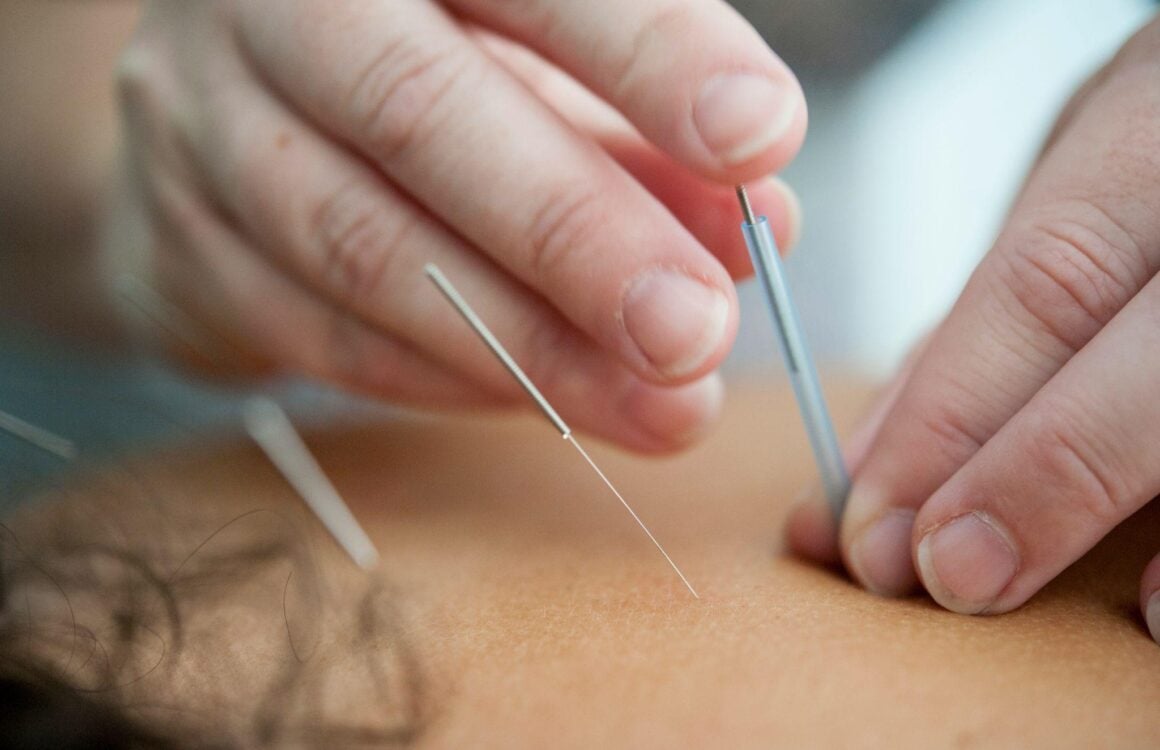
Acupuncture means inserting very fine needles into the skin, sometimes with a small electrical current running through them. According to the US National Center for Complementary and Integrative Health (NCCIH), the share of US adults using it rose from 1.0 percent in 2002 to 2.2 percent in 2022, most often for back, joint or neck pain.
Athletes use it more than the general public in some places. A 2024 systematic review found that use ranged from 2.2 percent among college athletes in one study to 61 percent among professional football players in the Netherlands. They used it mainly for muscle soreness and for pain from injuries.
What the research shows
Chronic pain has the strongest evidence. A meta-analysis in The Journal of Pain pooled individual data from 39 trials and 20,827 patients with back and neck pain, osteoarthritis, headache or shoulder pain. Acupuncture did better than no acupuncture and better than sham acupuncture for each condition, and the effects lasted over time.
NCCIH adds an important detail. The gap between real and sham acupuncture is smaller than the gap between acupuncture and no treatment. That suggests part of the benefit comes from expectation and from the attention of the practitioner.
Where the needles go may matter. In a small set of studies on muscle pain with trigger points, summarized by NCCIH, needling the trigger points reduced pain and needling traditional acupuncture points did not.
For soreness after training, two reviews disagree. A 2020 meta-analysis in Frontiers in Physiology pooled six randomized trials and found that acupuncture reduced muscle soreness, with the largest effect 72 hours after exercise. A second review from the same year covered 15 studies and found no significant difference between acupuncture and sham or control, except on the first day.
None of these reviews measured flexibility. They measured pain, soreness and function. Whether acupuncture improves range of motion is a separate question that they don’t answer.
Fitting it around training
If you decide to try it, a few habits make it easier to tell whether it is doing anything:
- Book sessions on rest days or light days, away from heavy swings, squats and presses.
- Keep a short log of sleep, how the same exercise felt and what weight you used. Judge it after a few weeks.
- If a joint moves more freely afterward, use that range in your next session with a light kettlebell.
Acupuncture is an addition to training, sleep and sensible loading, and it replaces none of them.
How to check a practitioner
Complications from acupuncture are uncommon. NCCIH says they have resulted from nonsterile needles and improper technique, and that they can be serious, including infections and punctured organs. The US Food and Drug Administration regulates the needles as medical devices and requires them to be sterile and single use.
Most US states license acupuncturists, and the requirements vary by state. According to NCCIH’s page on credentialing, most states require certification from the National Certification Commission for Acupuncture and Oriental Medicine, or a pass in its exams. You can usually confirm a license on your state board’s website.
Before a first session, ask:
- What is your license number, and which state issued it?
- Do you use only sterile, single-use needles?
- Have you worked with people who do strength training?
- How many sessions do you expect, and how will we know whether it is working?
- How should sessions fit around my training days?
It also helps to know what clinics expect when they hire. These current job listings for acupuncturists show it clearly. When this article was written, the employers included physical therapy and sports medicine practices, large hospital groups and university cancer centers. Several listings asked for a valid state acupuncture license, and one asked for a master’s degree or equivalent certificate from an accredited school. Anyone who treats you should be able to show the same credentials.
This article is for education and isn’t medical advice. See a doctor or physical therapist for pain that persists, travels or follows an injury.
References
- Weppler CH, Magnusson SP. Increasing muscle extensibility: a matter of increasing length or modifying sensation? Phys Ther. 2010;90(3):438–449. https://doi.org/10.2522/ptj.20090012
- Afonso J, Ramirez-Campillo R, Moscão J, et al. Strength training versus stretching for improving range of motion: a systematic review and meta-analysis. Healthcare (Basel). 2021;9(4):427. https://doi.org/10.3390/healthcare9040427
- National Center for Complementary and Integrative Health. Acupuncture: effectiveness and safety. https://www.nccih.nih.gov/health/acupuncture-effectiveness-and-safety
- Chaabna K, Jithesh A, Cheema J, Aboughanem J, Mamtani R. Western medical acupuncture perception and use for pain management among athletes: a systematic review. J Pain Res. 2024;17:357–366. https://doi.org/10.2147/JPR.S441869
- Vickers AJ, Vertosick EA, Lewith G, et al. Acupuncture for chronic pain: update of an individual patient data meta-analysis. J Pain. 2018;19(5):455–474. https://doi.org/10.1016/j.jpain.2017.11.005
- Huang C, Wang Z, Xu X, Hu S, Zhu R, Chen X. Does acupuncture benefit delayed-onset muscle soreness after strenuous exercise? A systematic review and meta-analysis. Front Physiol. 2020;11:666. https://doi.org/10.3389/fphys.2020.00666
- Chang WD, Chang NJ, Lin HY, Wu JH. Effects of acupuncture on delayed-onset muscle soreness: a systematic review and meta-analysis. Evid Based Complement Alternat Med. 2020;2020:5864057. https://doi.org/10.1155/2020/5864057
- National Center for Complementary and Integrative Health. Credentialing, licensing, and education. https://www.nccih.nih.gov/health/credentialing-licensing-and-education
- Workouts
- Courses
- Certifications
- Coaches
- Live feed


