
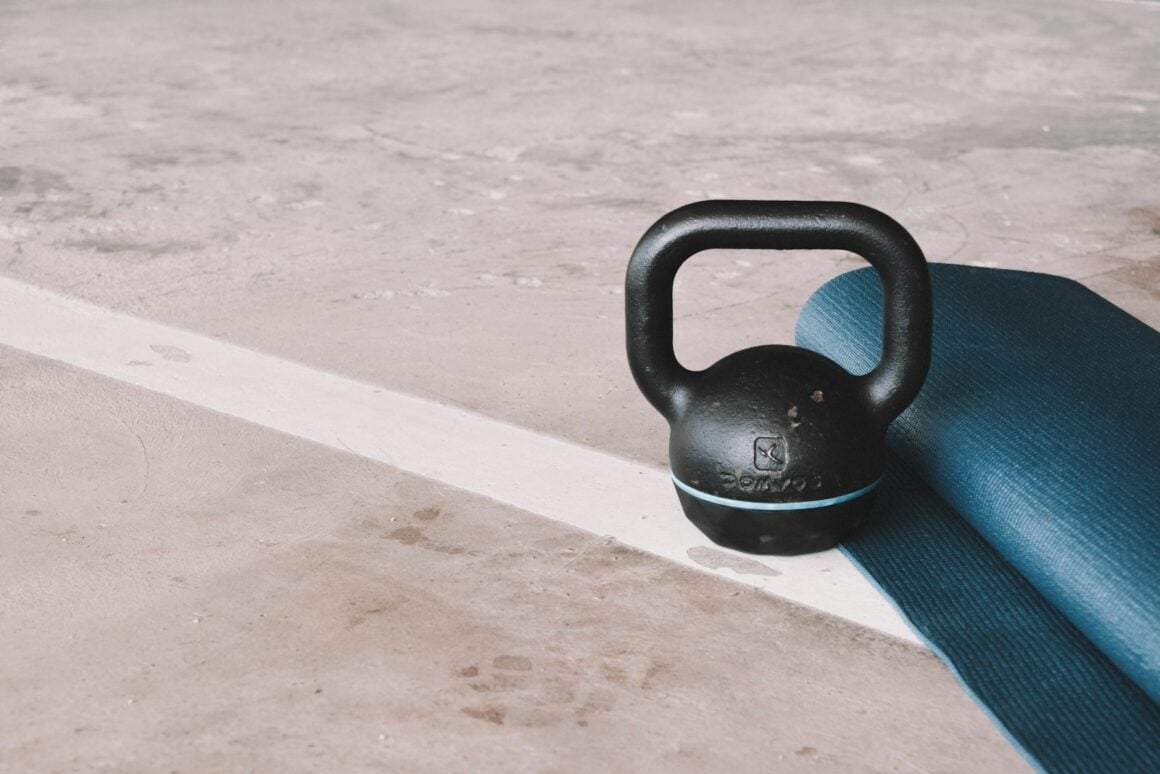

The first session lasted about four minutes.
A friend’s son came out to the garage because he’d been told to. He put his phone face down on the bench, did eleven swings with a 12 kg kettlebell, said his back hurt, and went back inside.
My friend thought the session had been a failure. It wasn’t.
Four months later, the two of them were training three mornings a week before school. They still didn’t talk much during the sessions. That was fine.
If you have a teenager who’s gone quiet on you, training can give you something useful to do together without forcing a conversation.
It can help more than you might expect. It also has limits.
Why training can work when talking doesn’t
Sitting a fifteen-year-old down at the kitchen table and asking what’s wrong can feel like an interrogation, even when that isn’t your intention. Training beside them is different.
You don’t have to make eye contact. You don’t have to fill every silence. You’re both doing something, and the conversation doesn’t have to be the point of being there. There is also something useful about both of you being bad at things.
A teenager spends a lot of time around adults who already know the answer. At school, in sport, at home, somebody is usually teaching, correcting or judging. Training can be different if you let it. You miss a clean. They mess up a squat. You both get tired. Nobody has to pretend.
Even the breathing that comes with swings can help give somebody something simple to focus on. Breathe out at the top, breathe in on the way back. You don’t need to call it breathwork. In fact, with a teenager, I probably wouldn’t.
What the research supports
A 2023 systematic review in JAMA Pediatrics looked at 21 trials involving physical activity interventions in children and adolescents.
Overall, physical activity reduced depressive symptoms compared with control conditions.
Two things stood out.
The effect was larger in participants over 13 and in those who already had diagnosed mental illness or depression.
That matters because parents can easily assume that exercise is only useful for a kid who’s a little down, not one who’s genuinely struggling.
The research doesn’t support that assumption.
The second interesting finding was that more training did not automatically mean better results.
Total training volume did not appear to drive the benefit. Programmes with three sessions per week and those lasting less than twelve weeks tended to perform better than longer interventions.
So this does not have to become a huge training project. Three sessions a week may be plenty.
There is also research on resistance training and depressive symptoms, although the evidence here is mainly from adults.
A 2018 meta-analysis in JAMA Psychiatry looked at 33 randomised trials involving 1,877 adults and found that resistance training reduced depressive symptoms.
Interestingly, the improvement was not linked to whether participants actually became stronger.
That does not prove the same thing happens in teenagers, but it does suggest that the value of resistance training may go beyond adding weight to the bar or kettlebell.
A teenager does not have to become strong quickly for the training to be worthwhile.
Starting properly matters
The idea that sensible resistance training stunts a young person’s growth has not been supported by the evidence for a long time.
The 2014 international consensus statement published in the British Journal of Sports Medicine concluded that properly supervised and appropriately prescribed resistance training can be safe for young people.
But the important words there are properly supervised and appropriately prescribed.
Technique first.
Load later.
Progress gradually.
Handing a teenager a heavy kettlebell after they watched a swing tutorial on a phone is not what the research is talking about.
The fundamentals of kettlebell training matter here: starting weight, grip, rack position and basic movement patterns before you expect somebody to perform a good swing.
Looking back, that’s also where we got that first four-minute session wrong. Eleven swings probably should not have been where we started.
One thing I have found useful is letting the teenager choose some of what they do. Give them a list of kettlebell exercises and let them pick a few they want to learn. That small amount of choice can matter.
Teenagers spend a large part of their day being told what they have to do. Training does not need to become another version of that.
Don’t turn every session into coaching
This is where parents can ruin something that was working.
You know how to swing, so you correct the swing.
Then you correct the squat.
Then the grip.
Then the breathing.
Before long, every rep comes with another instruction.
Now the training session feels exactly like everything else in their life: another adult telling them what they’re doing wrong.
Sometimes it works better to stop being the coach.
Put on a full-length follow-along kettlebell workout and do it with them.
Take the same instructions.
Get tired at the same time.
Miss a rep yourself.
You’re still their parent, obviously, but during that session you can just train together.
That can be enough.
Things worth paying attention to
Training is not a way to diagnose depression, substance use or anything else.
But spending regular time beside your kid may make changes easier to notice.
Some things are worth taking seriously, particularly when several start happening together:
- Sleep becoming broken or very irregular
- Losing interest in things they used to care about
- Money or possessions disappearing without a clear explanation
- Noticeable changes in appetite or body weight over a short period
- A complete change in friendship group
- Talking about being a burden
- Saying that nothing matters
None of these proves anything by itself.
They are reasons to pay attention and, when necessary, involve somebody qualified to help.
Training is support, not treatment
This part matters.
A regular training habit can give somebody structure. It can improve physical health. It can give a parent and teenager time together without forcing a conversation.
It is not treatment for a substance use disorder.
If you already suspect that your child is dealing with something at that level, don’t use the fact that they’re still getting up to train with you as evidence that everything is under control.
A 2025 study in JAMA Health Forum used national survey data from more than 32,000 Americans aged 12 to 20.
Only around 10% of young people identified as having a substance use disorder received treatment.
There are a lot of barriers to care, and families can end up trying to manage things themselves for longer than they should.
A routine can help.
A routine can also make things look more stable than they really are.
If home routines and outpatient care are not enough, it can be useful to understand what more intensive care actually involves rather than dismissing it before looking into it.
Cenikor, a treatment provider in Texas, describes residential treatment for teenagers as providing structure, help with stress and cravings, work on family relationships, and planning for what happens after treatment.
Whatever provider you speak to, that last part is worth asking about.
What happens after they leave?
A programme can look excellent while somebody is there. What matters just as much is what support exists when normal life starts again.
If there is an immediate safety concern, get urgent help. In the US, the 988 Suicide & Crisis Lifeline is available around the clock. Elsewhere, contact your local emergency number or crisis service.
Keep the training
You do not have to stop training with them just because something more serious is going on.
Keep the routine if they still want it.
Keep showing up.
Four minutes in a garage is not treatment.
But if a teenager who has stopped talking to you still comes out and trains beside you, I wouldn’t dismiss those four minutes either.
Sources
Recchia F, Bernal JDK, Fong DY, et al. Physical Activity Interventions to Alleviate Depressive Symptoms in Children and Adolescents: A Systematic Review and Meta-analysis. JAMA Pediatrics. 2023;177(2):132–140. https://doi.org/10.1001/jamapediatrics.2022.5090
Gordon BR, McDowell CP, Hallgren M, Meyer JD, Lyons M, Herring MP. Association of Efficacy of Resistance Exercise Training With Depressive Symptoms: Meta-analysis and Meta-regression Analysis of Randomized Clinical Trials. JAMA Psychiatry. 2018;75(6):566–576. https://doi.org/10.1001/jamapsychiatry.2018.0572
Lloyd RS, Faigenbaum AD, Stone MH, et al. Position statement on youth resistance training: the 2014 International Consensus. British Journal of Sports Medicine. 2014;48(7):498–505. https://bjsm.bmj.com/content/48/7/498
Lee D, Dusetzina SB, Patrick SW, Graves JA, Fry CE. Adolescent Treatment Landscape of Depression, Suicidality, and Substance Use Disorder in the US. JAMA Health Forum. 2025;6(8):e252647. https://doi.org/10.1001/jamahealthforum.2025.2647
- Workouts
- Courses
- Certifications
- Coaches
- Live feed


