

If you are over 50 and have never touched a kettlebell, this article is for you. Not because you are fragile. Because you are not — and the science says you have far more capacity than anyone has told you.
In this article:
- The Lie You Have Been Sold
- Why a Kettlebell
- What You Need to Understand Before You Start
- Where to Start
- The Movements That Matter
- What Not to Do
- The Long View
- Sources
The Lie You Have Been Sold
Somewhere along the way, the fitness industry decided that people over 50 need a different category. Softer exercises. Lighter loads. Chair workouts. Rubber bands. A general atmosphere of caution, as if turning 50 flipped a switch that made your body incapable of doing real work.
It did not.
We don’t move according to our age — we age according to how we move. The science behind that statement is extensive. A 2018 meta-analysis by García-Hermoso et al. pooled data from approximately 2 million people across 38 studies and found that muscular strength is one of the most important predictors of all-cause mortality — regardless of age [1]. Not cardio. Not flexibility. Strength.
And a landmark 1994 study published in the New England Journal of Medicine took 100 nursing home residents — frail, with a mean age of 87 — and put them on a 10-week resistance training program. The result: 113% average increase in leg strength. Participants who had been using walkers switched to canes [2].
If people in their late 80s and 90s can respond to resistance training that dramatically, the idea that a healthy 50-year-old needs to be handled gently is not caution. It is misinformation.
Why a Kettlebell
There are many tools that work for strength training. Barbells, dumbbells, cable machines, bodyweight — all of them follow the same principle of progressive overload. The tool is secondary to the principle.
But for someone starting over 50, the kettlebell has a few practical advantages that make it unusually well-suited.
First, it is a single piece of equipment. One kettlebell, appropriate weight, and you have enough to train your entire body. No gym membership required. No complicated setup. No waiting for machines.
Second, the design of the kettlebell — with the mass below the handle — naturally teaches the body to stabilize. Every rep demands core engagement, grip strength, and coordination. These are not extras for older adults. They are priorities. Grip strength alone is one of the strongest predictors of functional independence as you age.
Third, kettlebells lend themselves to movement patterns rather than isolated muscles. A kettlebell swing is a hip hinge. A goblet squat is a full-body squat pattern. A press is a press. These are the patterns that transfer directly to real life — picking things up, standing up, putting things overhead, carrying loads. Training these patterns is not just exercise. It is rehearsal for the physical demands of daily living.
Fourth, progression is built into the tool. You do not need to load plates or adjust cables. You learn a movement with a lighter bell. When it becomes manageable, you move to a heavier one. Simple, clear, sustainable.
What You Need to Understand Before You Start
A kettlebell workout for beginners over 50 is the same as a kettlebell workout for beginners at any age. The principles do not change because you have more years behind you. What changes is patience and respect for where you are starting from.
Here is what that means in practice.
If you have been sedentary for years or decades, your muscles, joints, and connective tissues have adapted to inactivity. They have not broken — they have simply downregulated. They are waiting for a reason to rebuild. But the rebuilding takes time, especially in tendons and ligaments, which adapt more slowly than muscle. Rushing that process is the only real danger.
The research is clear on this: a Cochrane review of 121 randomized controlled trials involving approximately 6,700 older adults found that resistance training performed 2 to 3 times per week produces significant improvements in strength, walking speed, and the ability to rise from a seated position [3]. Two to three times per week. Not every day. Not twice a day. Consistent, moderate frequency applied over months and years.
This means your starting point is not your limitation. It is your baseline. And baselines change — quickly — when the stimulus is right.
Where to Start
Before you pick up a kettlebell, you need to be able to move your own body through the basic patterns. This is not optional. It is the foundation that makes everything else safe and effective.
The patterns that matter are the squat, the hip hinge, the press, the pull, and the carry. If you cannot perform a bodyweight squat to a reasonable depth with control, adding load to that pattern will not help you. It will reinforce a problem. If you cannot hinge at the hips without rounding your lower back, a kettlebell swing is not the next step — it is several steps away.
Spend time on bodyweight movement first. How much time depends entirely on where you are. Some people are ready in days. Some need weeks. There is no shortcut through this, and there should not be. The time you invest in learning to move well without load is the single best investment you can make in your long-term training.
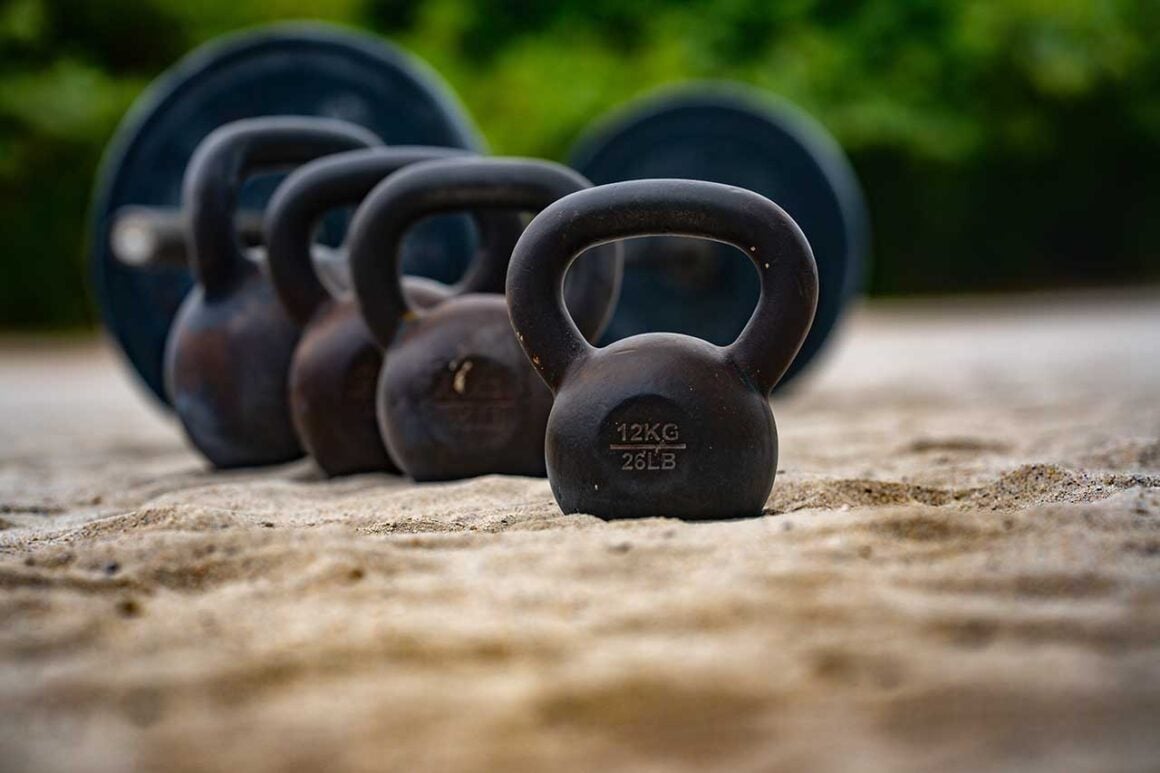
When you are ready for load, start light. For most men over 50 with no training history, an 8 kg or 12 kg kettlebell is a good starting point. For most women, 6 kg or 8 kg. These may feel too light for some movements. That is fine. You are not training for strength yet. You are training for competence. The strength comes later, and it comes fast once the movement quality is there.
The Movements That Matter
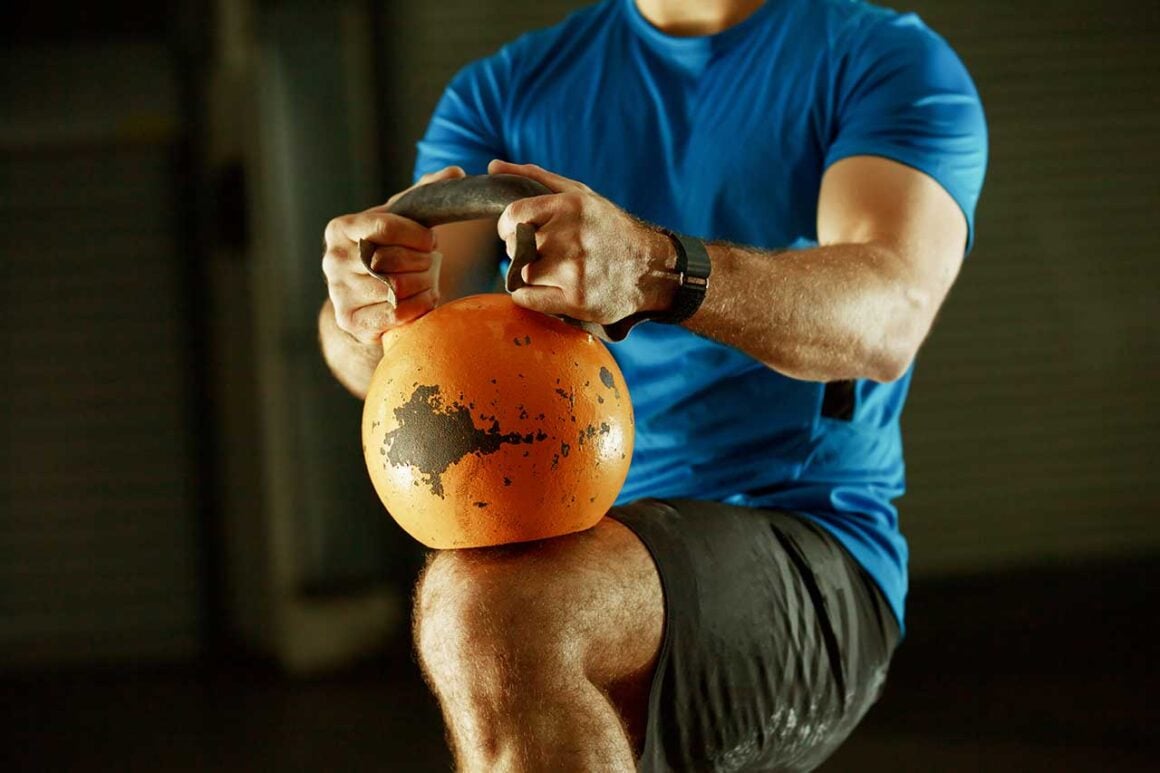
A solid beginner kettlebell program does not need to be complicated. Five or six movement patterns, trained 2 to 3 times per week, with gradual increases in load and volume over time, will produce results that most people find surprising.
The deadlift teaches you to pick things up safely. It is the foundation of the hip hinge, and it is where every beginner should start before attempting a swing. You learn to brace, to hinge, and to drive through the floor with your legs while keeping your spine in a neutral position.
The goblet squat teaches you to sit and stand under load. It builds the quadriceps, glutes, and core simultaneously. The position of the kettlebell — held at the chest — naturally reinforces an upright torso, which makes it one of the most forgiving squat variations for people who are still developing mobility.
The kettlebell press teaches you to put something overhead safely. Shoulder stability, core bracing, and pressing strength are all trained in one movement. Start with one arm at a time. This also forces your core to work harder to resist rotation — a benefit that carries over to balance and stability in everyday life.
The row teaches you to pull. Most people — especially those who have spent years at a desk — are weak in the muscles of the upper back and posterior chain. Rows address this directly. A strong back is not a luxury. It is a requirement for posture, shoulder health, and the ability to carry things.
The swing comes last. Not because it is dangerous, but because it demands proficiency in the hip hinge, the ability to brace under dynamic load, and the coordination to generate and absorb force in a ballistic pattern. When you are ready for it, it is one of the most efficient exercises that exists — training the posterior chain, cardiovascular system, and grip in a single movement. But it must be earned through the earlier progressions.
The carry — simply walking with a kettlebell held in one hand or at the chest — is the most underrated exercise for beginners over 50. It trains grip, core stability, posture, and the ability to move under load. It is also the most directly functional movement you can train. Life requires carrying things. Train it.
What Not to Do
Do not follow a random YouTube workout without understanding the movements first. A video cannot see your form, correct your mechanics, or tell you when something is wrong. Learn the movements deliberately, practice them without weight, and add load only when the pattern is sound.
Do not train to failure. This is important at any age, but especially for beginners over 50 whose connective tissues are adapting at a different rate than their muscles. Your muscles may feel ready for more before your tendons are. Leave repetitions in reserve. Stop each set with 2 to 3 reps still available. This approach builds strength without accumulating damage, and it is consistent with how the most successful long-term training programs are structured.
Do not skip recovery. A review in Sports Medicine noted that a 70-year-old can restore muscle strength to levels comparable to much younger adults in a matter of weeks — but only if recovery is adequate between sessions [4]. Training is the stimulus. Recovery is where the adaptation happens. Sleep, nutrition, and rest days are not weaknesses in a program. They are the program.
Do not compare yourself to someone who has been training for years. Your trajectory is your own. The only comparison that matters is where you are now versus where you will be in six months if you train consistently.
The Long View
The man who wrote to me was 58 years old. He had trained with kettlebells for a decade — self-taught, no coach, just consistent effort applied over time. At 58, he was not managing decline. He was expanding his training, adding new tools, building on a foundation that most people half his age do not have.
He is not an outlier. He is what happens when the stimulus is provided and maintained.
A kettlebell workout for beginners over 50 is not a modified version of real training. It is the beginning of real training — with appropriate load, appropriate progression, and appropriate respect for where you are starting. The biological machinery that builds muscle, strengthens bone, improves cardiovascular capacity, and maintains cognitive function does not care how old you are. It cares whether you are asking it to work.
The research confirms this across thousands of studies and millions of participants. The body does not have a predetermined expiration date for physical capacity. It has a use-dependent maintenance system that responds to demand — at 30, at 50, at 70, and beyond.
So the question is not whether you can start. The research settled that a long time ago.
The question is when.
Sources
[1] García-Hermoso, A. et al. (2018). Muscular strength as a predictor of all-cause mortality in an apparently healthy population. Archives of Physical Medicine and Rehabilitation. 99(10):2100-2113. PubMed
[2] Fiatarone, M.A. et al. (1994). Exercise training and nutritional supplementation for physical frailty in very elderly people. New England Journal of Medicine. 330(25):1769-1775. PubMed | NEJM
[3] Liu, C.J. & Latham, N.K. (2009). Progressive resistance strength training for improving physical function in older adults. Cochrane Database of Systematic Reviews. Issue 3. PubMed | PMC
[4] Unhjem, R.J. et al. (2024). Heavy strength training in older adults: implications for health, disease, and physical performance. Sports Medicine. PMC
[5] Wolff, J. (1892). Das Gesetz der Transformation der Knochen.
[6] CDC. Important Facts about Falls. Leading cause of injury death in adults 65+. CDC
- Workouts
- Courses
- Certifications
- Coaches
- Live feed


