
Somewhere along the way, we stopped paying attention to our feet. We wrap them in cushioned, narrow shoes from childhood and never think about them again — unless something hurts. We obsess over hip mobility, shoulder stability, and core bracing, but the structure that connects all of it to the ground gets ignored entirely.
That is a mistake. And the research on why starts with the last toe you would ever think about.
The One Nobody Looks At
Your fifth toe has its own dedicated muscle. It is called the abductor digiti minimi — Mini-Me, if you will. Small. Overlooked. Underestimated. But when Mini-Me stops working, the consequences reach far beyond the foot.
The abductor digiti minimi does three things. It pulls the little toe outward, away from the other toes. It flexes the little toe into the ground. And it supports the lateral longitudinal arch — the outside edge of your foot that makes first contact during every step you take.
If you have worn conventional shoes your whole life, this muscle is almost certainly weakened. Cadaveric research has found peroneus brevis tears in 11 to 37 percent of specimens. MRI studies on living, symptom-free individuals found peroneal pathology in 35 percent of them. The lateral foot is deteriorating in people who feel nothing wrong.
Here is a test. Try to spread your little toe outward, away from the other four, independently. If you cannot — and most people who wear shoes cannot — that tells you how dormant this muscle has become.
Why It Matters Beyond the Foot
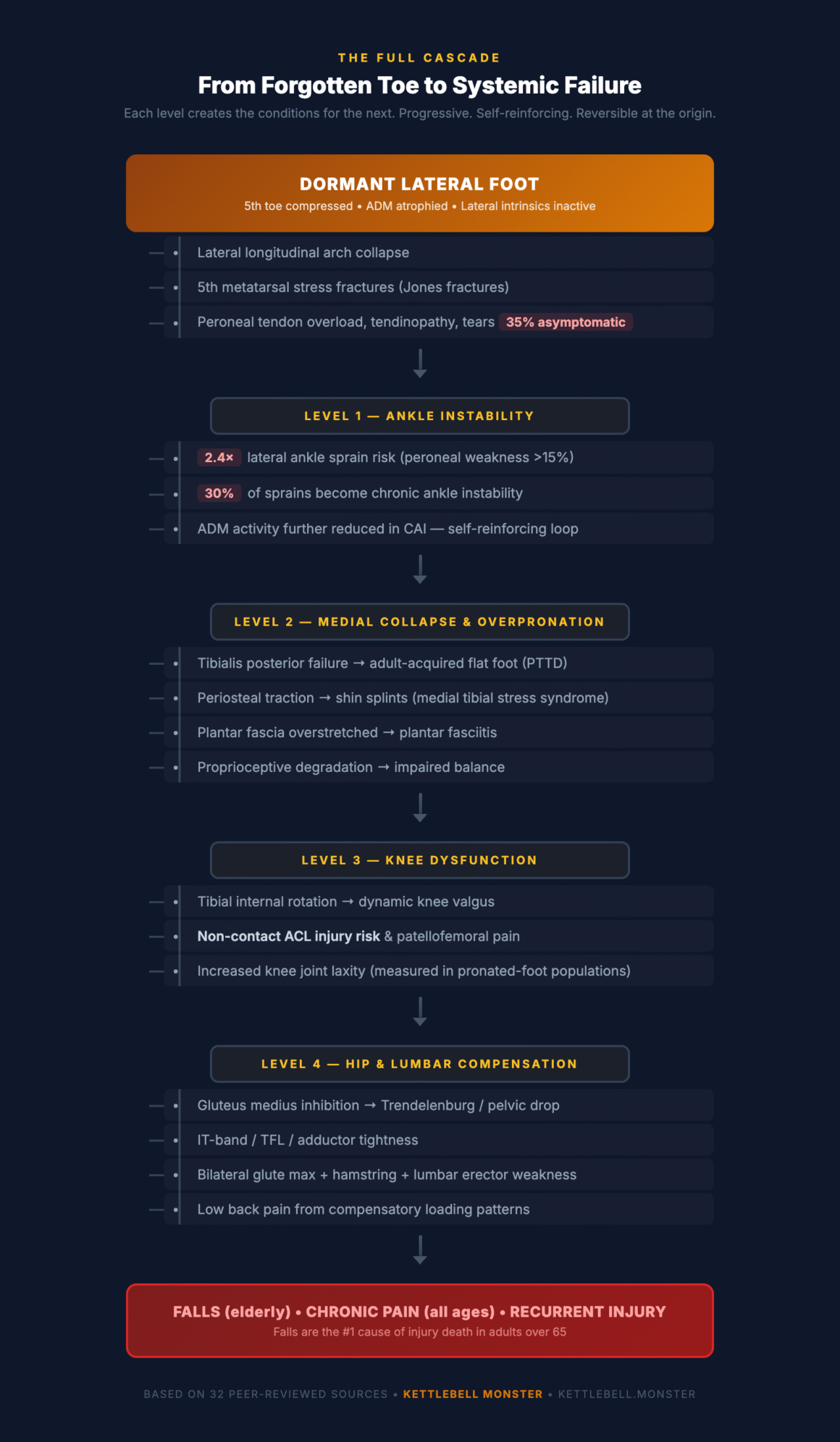
The fifth toe is the outermost point of your base of support. In structural terms, it sits at the maximum moment arm for lateral stability. When the muscle that controls it atrophies, the effects do not stay local. They travel upward, and the research documents each stage clearly.
Stage one is ankle instability. The peroneal muscles — the primary dynamic stabilisers of the lateral ankle — are already overcompensating for weak intrinsic foot muscles. A study published in the Journal of Physical Therapy Science found that individuals with chronic ankle instability had significantly reduced abductor digiti minimi activation on the affected side. The weaker the fifth toe abduction, the worse the ankle instability. Athletes with peroneal weakness greater than 15 percent asymmetry have a 2.4-fold increased risk of lateral ankle sprain, and roughly 30 percent of those sprains become chronic.
Stage two is medial collapse. When the lateral column of the foot cannot hold, the foot rolls inward. The tibialis posterior — the muscle responsible for supporting the medial arch — picks up the slack until it cannot anymore. This is the mechanism behind adult-acquired flat foot, shin splints, and plantar fasciitis. Research has shown that strengthening the hip abductors to control pronation from above reduced plantar fasciitis symptoms by 40 percent. The foot alone cannot fix what the whole chain created.
Stage three is the knee. Overpronation forces the tibia into internal rotation, dragging the knee inward under load. Dynamic knee valgus — inward collapse of the knee — is one of the strongest biomechanical predictors of non-contact ACL rupture and patellofemoral pain. A 2022 study found that pronated feet are associated with measurably increased knee joint laxity.
Stage four is the hip and lower back. Research published in the Journal of Orthopaedic and Sports Physical Therapy documented that even a single lateral ankle sprain weakens the bilateral gluteus maximus, hamstrings, and lumbar erectors — muscles nowhere near the ankle. The body compensates globally for a local instability at the foot.
Stage five is falls. Intrinsic foot muscle weakness is now recognised as a direct, modifiable contributor to falls in adults over 65, the leading cause of injury death in that age group.
One dormant muscle. Five levels of documented dysfunction. All starting from a toe most people have never thought about.
The Part Nobody Wants to Hear
Here is where it gets uncomfortable. We do not spread our toes because it looks strange. Splaying the little toe outward looks funny. We would rather stuff our feet into narrow, tapered shoes because they look good than let our feet function the way they were designed to. Aesthetics over biomechanics. And the body pays for it quietly, for years, until it cannot stay quiet anymore.
Dr. Phil Hoffmann documented this in 1905. He compared the feet of barefoot populations from the Philippines and Central Africa with shoe-wearing populations and found that the ability to spread the toes — universal in barefoot adults — was virtually absent in people who wore shoes. He wrote that it was rare to find a shoe-wearing adult with even the slightest strength of laterally separating the toes.
That was 120 years ago. The shoe industry has not changed. But the research validating Hoffmann has only grown.
What Actually Works
MRI activation studies have measured which exercises produce the highest recruitment of the abductor digiti minimi. The results are clear.
The toes-spread-out exercise — actively fanning all toes as wide as possible, getting the little toe way out laterally — produced 35.2 percent mean activation of the abductor digiti minimi. The short foot exercise, where you dome the arch without curling the toes, was close behind at 34.9 percent.
For broader foot strength, a 2021 study in Scientific Reports found that six months of daily activity in minimal footwear increased foot flexor strength by 57 percent on average. A 2025 systematic review confirmed significant improvements in foot muscle volume, arch function, and neuromuscular control from barefoot and minimalist footwear training.
Toe spacers are useful as a passive supplement — they help restore position — but they are not a substitute for active muscle training. Spacers hold the shape. Exercises build the control.
What This Means When You Pick Up a Kettlebell
Every kettlebell movement transmits force through the feet into the ground. When the lateral foot is dormant, it shows up everywhere.
In the squat, the foot should be a tripod — big toe, base of the little toe, and heel. When the lateral column is weak, the tripod collapses into two points and the knee dives inward.
In the Turkish get-up, the lateral foot has to stabilise through multiple transitions in single-foot stance while holding load overhead. A dormant fifth toe means the ankle is doing the stabilisation work alone.
In the single-leg deadlift, the entire lateral column is the primary stabiliser against side-to-side sway on one foot. If it is offline, the wobbling is not a balance problem. It is a foot strength problem.
In the swing, the explosive hip hinge needs a rigid foot platform. If the lateral column cannot hold, the foot rolls subtly inward on every rep and force leaks out of the system.
I have been coaching barefoot kettlebell training for over two decades. Every session starts with active toe splay. During squats, I cue pressing the base of the little toe into the ground. The difference in stability is noticeable within days. The difference in ankle confidence takes weeks. Knee pain that people have been managing for months starts fading within the first month.
The ground is the gym for the foot. Shoes are the cast that atrophied it.
Go Deeper
This article is a summary. The full science — all five levels of the cascade, the complete anatomy, 28 peer-reviewed citations, and specific intervention protocols — is available as a free, in-depth report in the Kettlebell Monster science hub.
Read the full “Ground Up” science course on Kettlebell Monster →
The course covers everything from how shoes destroy your feet to how to rebuild them, with every claim backed by published research. This is what evidence-based kettlebell education looks like.
Sources
- Hoffmann P. “Conclusions Drawn from a Comparative Study of the Feet of Barefooted and Shoe-Wearing Peoples.” Am J Orthop Surg, 1905.
- Shu Y et al. “Foot shape and plantar pressure relationships in shod and barefoot populations.” Biomech Model Mechanobiol, 2019.
- Chen TL et al. “Automatic Classification of Barefoot and Shod Populations Based on Foot Metrics and Plantar Pressure Patterns.” Front Bioeng Biotechnol, 2022.
- Holowka NB et al. “Foot strength and stiffness are related to footwear use in minimally- vs. conventionally-shod populations.” Sci Rep, 2018.
- Franklin S et al. “Daily activity in minimal footwear increases foot strength.” Sci Rep, 2021.
- “Peroneal Tendon Syndromes.” StatPearls / NCBI Bookshelf, 2024.
- “Peroneal tendon disorders.” Muscles Ligaments Tendons J, 2017.
- “Elucidation of abductor digiti minimi activity in chronic ankle instability.” J Phys Ther Sci, 2022.
- “Ankle Stability and Movement Coordination Impairments: Clinical Practice Guidelines.” JOSPT, 2013.
- “Degree of Impact of Tailor’s Bunion on Quality of Life.” J Clin Med, 2021.
- Gooding TM et al. “Intrinsic Foot Muscle Activation During Specific Exercises: A T2 Time MRI Study.” J Strength Cond Res, 2016.
- “Effects of Barefoot and Minimalist Footwear Strength-Oriented Training.” Sports, 2025.
- “Age-Related Reduction of Foot Intrinsic Muscle Function and Postural Stability.” J Clin Med, 2024.
- “Effect of Systematic Corrective Exercises on Balance in Pronation Distortion Syndrome.” Healthcare, 2021.
- “Determining the knee joint laxity between the pronated foot and normal arched foot.” BMC Musculoskelet Disord, 2022.


