
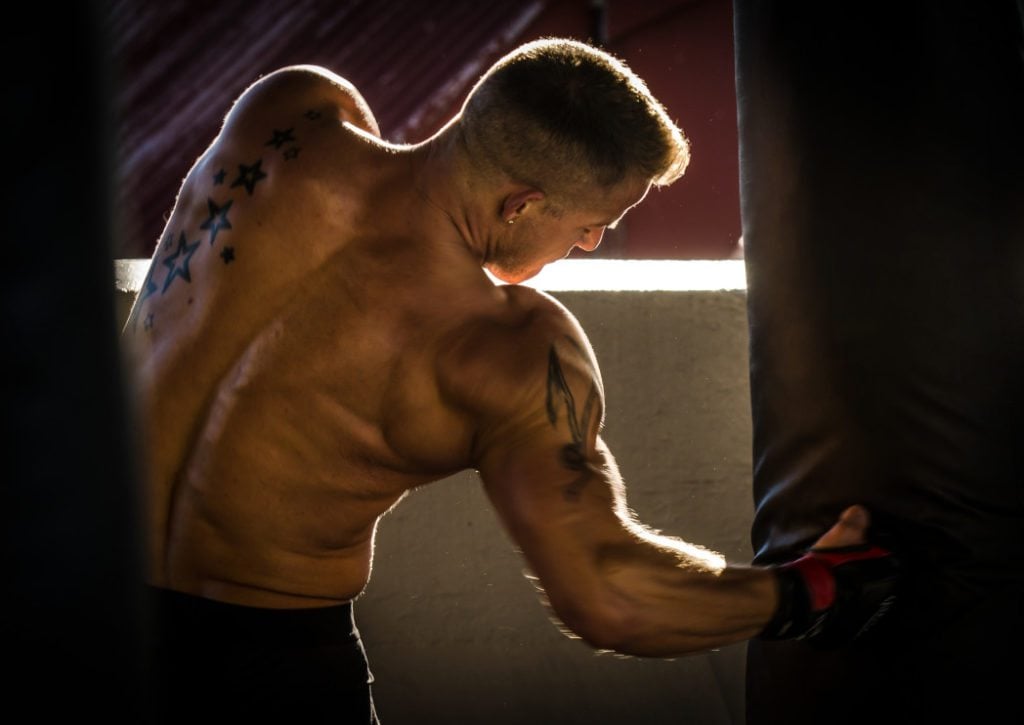

Combat athletes train for a specific set of demands: produce force quickly, hold a grip under fatigue, and keep working at a high heart rate. Kettlebells suit those demands because the load sits offset from the handle, so the body has to stabilize on every rep. That stabilization requirement is closer to clinch and scramble positions than a barbell’s fixed bar path.
Used with intent, kettlebells develop strength without costing speed or endurance. The value comes from a small number of well-chosen lifts programmed around your sport. Adding movements for novelty works against that.
Key Principles of Kettlebell Application
Results come down to three things: picking appropriate weights, training the core movement patterns, and adjusting the program to your combat sport.
Selecting the Right Kettlebell Weight
Weight depends on your experience and the lift. A common starting point for the basics, such as swings and goblet squats, is 16kg (35lb) for men and 8kg (18lb) for women.
With two hands on the bell, as in a two-hand swing, you can usually load heavier than with single-arm work. Swinging 24kg while pressing 16kg overhead with one arm is normal.
Strength level matters more here than combat background. A strong wrestler who is new to kettlebells should still start with moderate loads to build the movement first. Heavy bells with poor technique cost training time and risk injury.
Most combat athletes are covered by three sizes: a lighter bell for high-repetition conditioning, a medium bell for strength work, and a heavy bell for low-repetition power.
Fundamental Movement Patterns
Most of the power-oriented kettlebell lifts share one pattern: the hip hinge. In a hinge-style swing, clean, or snatch, the hips load back and then extend hard, and that extension drives the bell. This is the Hardstyle and hip-hinge family, and it is the version most relevant to producing force for takedowns and strikes.
It is not the only swing. Sportstyle (pendulum) swings trade peak power for a smoother, more economical rhythm suited to high-repetition conditioning, and freestyle flows serve different goals again. When the aim is power transfer, prioritize the hinge-style swing.
In the hinge-style swing, force comes from hip extension rather than the arms. The arms guide the bell; they do not lift it. Electromyography work on the two-hand swing shows the movement is driven by the posterior chain, with gluteal activation near 80% and low-back extensor activation near 50% of a maximal voluntary contraction using a 16kg bell [5]. That hip drive is the same action used to shoot a takedown or commit bodyweight into a strike.
The Turkish get-up trains whole-body stability and the ability to organize yourself from the floor to standing under load. The range of positions it passes through overlaps with getting up off the mat and fighting for position. It also loads the shoulders, core, and transitions between positions.
Goblet squats, presses, and rows cover the remaining basics and build strength for grappling and clinch work. Technique carries more here than load.
Sport-Specific Programming
Strikers and grapplers can bias their selection differently. Boxers and kickboxers benefit from higher-repetition swings for repeated-round endurance, where a Sportstyle pendulum rhythm fits well. Wrestlers and jiu-jitsu athletes benefit from grip-loaded work such as bottoms-up carries and farmer’s walks.
Two to three kettlebell sessions a week, placed on the same days as technical training, keeps hard and easy days separate. Twenty to thirty minutes per session is enough.
Loaded conditioning, such as swing intervals, trains strength and endurance in the same set, which is efficient when training time is limited.
In a fight camp, keep the selection simple: circuits of swings, get-ups, and presses. Save flows and advanced variations for the off-season, when recovery capacity is higher.
Enhancing Athletic Performance Through Kettlebell Workouts
Kettlebell work targets the demands of combat sport: explosive power from hip-dominant lifts, strength that holds up in unstable positions, and core stability through hard exchanges. Cardiovascular conditioning and mobility can be trained alongside the same lifts.
A note on what the research supports. The studies below were run on general, recreational, and field-sport athletes, not on fighters, and the transfer of kettlebell work to actual competition performance has not been directly tested in combat athletes. Some transfer questions are also unsettled in the wider literature. The case for using kettlebells in combat sport rests on two things: measured improvements in the underlying qualities (power, posterior-chain strength, conditioning) and the mechanical similarity between these lifts and fighting actions. Treat the studies as evidence for the qualities, not as proof of a better fight result.
Improving Explosive Power and Speed
The rate at which you produce force determines how hard a strike lands and how fast a takedown commits. Ballistic kettlebell lifts ask the muscles to contract quickly against the load, which trains fast-twitch recruitment.
When the mechanical demands of the swing were measured against the back squat and jump squat, peak and mean power during the swing were greater than the back squat and comparable to the jump squat [1]. In a six-week training study, twice-weekly swing training raised half-squat one-repetition maximum and vertical jump height in healthy men, with the strength gain similar to a jump-squat power program [2]. Worth noting for balance: a comparison study found traditional weightlifting produced larger raw strength gains than swings, so the swing is often better used to add power on top of a strength base rather than as the only strength lift.
Hinge-style swings train the posterior chain to fire fast. Snatches and cleans add a pulling component on top of that.
Options for speed-strength:
- Hinge-style swings: 15-20 reps for hip explosiveness
- Single-arm snatches: 8-10 reps per side for whole-body power
- Double kettlebell cleans: 6-8 reps for pulling strength
Move the bell fast rather than chasing load. Speed of movement is what builds the relevant force production.
Building Functional Strength
Combat sports demand strength across multiple planes and often in unstable positions. The offset load of a kettlebell keeps the stabilizers working on every rep, which suits that requirement.
There is evidence that this functional strength transfers to other lifts. After a ten-week kettlebell program, participants across a wide age range improved their barbell bench press and clean and jerk against a control group [3]. The Turkish get-up builds whole-body strength and coordination through a long range of motion, similar to scrambling up from the mat or fighting for position. Overhead presses and goblet squats require continuous core engagement and load the grip, which carries over to clinch and grappling.
Because the bell is always being balanced and controlled, the body learns to produce force in positions closer to those it meets in a fight.
Developing Core Stability and Endurance
The core anchors both taking hits and producing power. Kettlebell lifts load the trunk through anti-rotation and anti-extension patterns, which help protect the spine when positions get awkward. In the swing, the high posterior-chain activation noted earlier is reached while spine compression stays comparatively low, well under the loads seen in a heavy deadlift, which is part of why the swing is often used to train the posterior chain without heavy axial loading [5].
Windmills and bottoms-up presses require strong trunk control to hold form. The bottoms-up carry in particular challenges grip and shoulder stability, which matters for clinch and grappling [5]. The obliques, transverse abdominis, and lower back work to keep the torso steady against an off-center load.
Kettlebell complexes string swings, cleans, presses, and squats together with little or no rest, which builds the muscular endurance needed to stay strong across rounds. High-intensity snatch work can also raise aerobic capacity: a four-week protocol of 15 seconds of snatching alternated with 15 seconds of rest increased maximal oxygen uptake by about 6% in collegiate athletes [4]. The aerobic effect is clearest with this kind of high-intensity interval work; lighter, lower-effort swing sessions have shown weaker and less consistent cardiovascular results, so intensity is the variable that matters.
Integrating Mobility and Flexibility Drills
Combat athletes need range of motion they can control under load, not just passive flexibility. Kettlebell drills move joints through a full range while managing the offset weight.
The kettlebell halo opens the shoulders and adds thoracic rotation, which supports head movement and slipping. Cossack squats with a bell held at the chest develop hip mobility and strength at the wide angles that come up in grappling.
| Exercise | Primary benefit | Reps / duration |
| Kettlebell halo | Shoulder mobility | 5 each direction |
| Tactical frog stretch with KB | Hip flexibility | 30-60 seconds |
| Arm bar stretch | Thoracic rotation | 45 seconds per side |
Use lighter bells for mobility work, either in the warm-up or between heavier sets. Loaded stretching is not always comfortable, but it builds range of motion you can use when movement gets dynamic.
References
- Lake JP, Lauder MA. Mechanical demands of kettlebell swing exercise. Journal of Strength and Conditioning Research. 2012;26(12):3209-3216.
- Lake JP, Lauder MA. Kettlebell swing training improves maximal and explosive strength. Journal of Strength and Conditioning Research. 2012;26(8):2228-2233.
- Manocchia P, Spierer DK, Lufkin AKS, Minichiello J, Castro J. Transference of kettlebell training to strength, power, and endurance. Journal of Strength and Conditioning Research. 2013;27(2):477-484.
- Falatic JA, Plato PA, Holder C, Finch D, Han K, Cisar CJ. Effects of kettlebell training on aerobic capacity. Journal of Strength and Conditioning Research. 2015;29(7):1943-1947.
- McGill SM, Marshall LW. Kettlebell swing, snatch, and bottoms-up carry: back and hip muscle activation, motion, and low back loads. Journal of Strength and Conditioning Research. 2012;26(1):16-27.
- Workouts
- Courses
- Certifications
- Coaches
- Live feed


